I took a break from paying attention to AI this summer. I thought I’d feel left behind when I came back. But coming back, I realized not that much had changed. There are new models, new techniques, new agents.
But making great products, growing revenue, and building a business is still hard.
The tools are clearly getting better. We can do more, faster. But I think the more important question is whether we’re making better things. Are our teams getting better, or are we just getting faster?I don’t think the answer is clearly yes.
There’s a lot of focus on making tools, using tools, and building systems around them. But as product people, our job is still to make something great.
People keep asking how companies like Ramp, Linear, and Anthropic ship so much software with agents. There is no new SDLC or secret set of tools. The tools are increasingly available to everyone. You can build your own, use Linear, Claude, or whatever works.
The bigger difference is ambition. These companies encourage their teams to build more, experiment more, and let agents do more of the work. That's the main different between "AI native" or not. You try to use the technology to the max.
But don't get there by adopting a tool, you change your beliefs.
So in the very simplest way:
- let agents build
- automate what you can
- make it easier and faster to contribute
- increase the ambition of what your teams attempt.
In practice, that means things like:
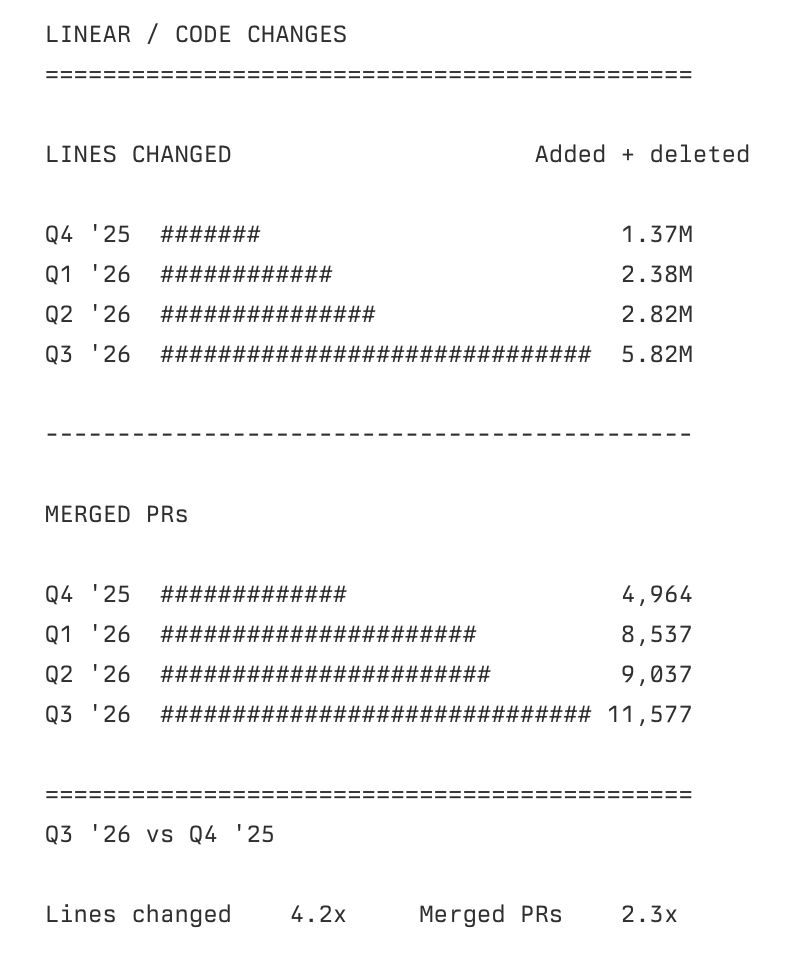
- Standardize around cloud agents. Most of our code (5M lines last quater) is now written in Linear with our Linear cloud coding agent. Cloud sandboxes make standardizing the system and environment easier for everyone and enables faster contributions
- Linear agent (with code access and cloud agent) operates in Slack too. If there is a discussion or someone notices a problem just say "@linear fix this" (decrease the time from something noticed to fixed)
- As bugs, errors etc arrive in Linear, send them to Triage, and have Loop to auto-investigate (connect to tools like Sentry, Datadog), and write a fix
- Let designers, PMs, non-technical people contribute code where useful. If they notice a problem, tell them they can submit a fix. If they want to try something, ask them to build a prototype.
- Set up code review agent and systems to make sure PRs are safe to merge.
- Run security as an automation, have agents constantly try to find security issues in your codebase, as they find, send it to a coding agent
- Instead of working on issue level, increase ambition, make a whole project, ask the agent to ask questions, investigate code base, create issues and have the agent work on the whole project at once.
- Bring customer feedback to the system like Linear, and make it available. At Linear every project now starts with 10-500 customer notes that influence the direction of the work, and which customers we should ask to test the solution first.
- Set up Loops/automations to constantly update reference documents for agents, like product area/code owners so work can be routed to right humans
Then what is left is how do you set direction for your teams (initiatives, projects they should work on) and how do you review results (better code review, Linear does it with Guided Reviews), how you maintain quality/cohesion which is not a new problem either.
At @linear we can help with automation, cloud agents, and code review, customer feedback and planning bits. But we can't change your mindset or how your company operates.
If your company is still spending energy debating jira workflow steps, you're probably solving the wrong problems.
I’ve never quite understood the appeal of software that gives you a blank canvas and building blocks to make your own tools. I’d rather use a purpose-built product from a team whose judgment I trust, or build something custom for my exact needs with AI.
The middle ground makes you do the design work, but limits you to someone else’s building blocks. In companies, everyone can end up building their own systems, leaving the organization to deal with the complexity.
This is why I like the house analogy more than LEGOs for software that’s supposed to help people do work.
A house has a structure. A kitchen is designed for cooking. A bathroom has plumbing. Within that structure, you can choose the furniture, decorate, rearrange things, and make the space your own.
Now imagine sharing that house with 1,000 people. Would it help if everyone could decide for themselves what each room was for? Before doing anything together, you’d have to figure out what everyone meant by a kitchen.
At Linear, we’ve deliberately designed shared concepts like issues, projects, and teams. People have freedom in how they organize and do their work, but they don’t need to invent their own definition of a project.
One of the values of that structure is that it gives the work a canonical place. It’s rare to see someone casually duplicate an entire project in Linear. People do this all the time with documents and spreadsheets. Eventually, someone has to figure out which copy reflects what’s actually happening.
There’s a different feeling when the system helps to represent the work. Changing something has consequences for how other people understand it and what happens next. You’re working in a shared reality rather than making another copy of it.
Ideally in organization I like to see freedom within structure. Not freedom to make the structure meaningless
I think making those structural decisions is part of our job as product builders. Leaving them open doesn’t remove the work. It asks every organization to do it themselves.
With AI making custom software easier to build, that middle ground feels increasingly hard to justify.
A purpose-built product should bring judgment about how the work fits together.
Otherwise, I’d rather have the freedom to build exactly what I need.

Linux. Git. SSH. MySQL. IRC.
All started by individual Finns. 🇫🇮
The key here is individuals. The more organizations or broader environment get involved, the worse it gets.
It’s nice to be proud of where these things came from. But what matters more is what you do with them.
European individuals can invent. But America is, ironically, a much better collective environment for trying new things and turning them into something impactful.
That’s why so many these ambitious people move there.
Building something great is and needs to be a shared ambition. This has been missing from Europe maybe the last 70-100 years. Ambition is very little at all. Shared ambition even less.
Especially now with AI, you can raise your ambition a lot. Build the best products in the world. Make rockets, satellites, drones, robots, software, drugs, whatever.
Remove councils. Fire the grey hair boards. Refuse to raise from the EU financier VCs. Incorporate in Delaware if you have to. Put talented individuals in charge.
Averaging everyone’s ideas doesn’t produce great work and working with people stuck in the past is not worth it.
Reset your thinking.
What would it take for you to be the best of your generation?
What’s the greatest thing you could possibly build?
How could you build it fast?
Make it better and make it matter

It’s easy to get absorbed in your Claude or Codex terminal right now. It feels like you can build anything, but it’s also easy to lose track of what you’re trying to accomplish.
“Agents and people are ripping. It’s great, but it’s unclear what value we’re creating.”
I hear versions of this from customers. We’re experiencing the same shift at Linear. Keeping a shared picture of the work is how I retain my sanity as things move faster.
I do all my AI work inside Linear. I learn, think, write, and adjust plans there because it's connected to what everyone is working on and what we’ve learned in the past.
This is why I think projects, initiatives, and teams become more useful as agents do more of the work. We need context and direction outside of individual agent sessions.
Projects give the work a home: issues, documents, customer feedback, milestones, updates. We also use them to follow adoption metrics. The work and the evidence of its impact stay together, often in an update I can glance at in the morning. I make projects even for personal work.
Teams establish conventions, triage rules, and automations.
Initiatives connect projects to something we want the company to accomplish, giving people and agents a broader purpose for their work.
A weekly Loop can pull together progress, with a person reviewing and adding judgment. Leadership can see what’s happening and adjust the direction.
This was useful before AI. Now, with the right guidance, AI can do much of the work of keeping that context current.
We’ve also connected Linear to our internal tools and data sources. I can explore a new area with our product history, customer feedback, revenue, usage, and ongoing work informing my thinking. Then start a proposal or discussion and adjust our plans.
That context is also available by tagging Linear in Slack or sending it a DM. A discussion can turn into “@linear how can we do this, what evidence we have?”.
Many tools give you access to the same models. What differs is what those models know about your company and what they can do with that knowledge.
Your people, history, decisions, customers, and current work are specific to your company. Making that knowledge available helps people and agents build on the advantages you already have.
The cathedrals are there for anyone who wishes to see them.
New post:
— Brand is who you are
I think brand is often misunderstood. People talk about it as the logo, the website, the colors. Those are the things you can see, so it’s natural to start there. But they are expressions of the brand. The underlying thing is who you are and what you stand for.
https://lnkd.in/gyBKZ6gZ