In 2009, we were building ZoomInfo out of a strip mall in Washington. I felt like such a LOSER next to Silicon Valley companies and remember thinking:
“Why doesn’t our business look like that??”
“Why isn’t Sequoia invested in us?”
“Why aren’t we growing as fast as they are?”
They had so much hype and great VCs. Box and Dropbox were raising round after round and getting all the press.
Meanwhile we were working out of our first “global HQ” - a tiny office in a seedy part of town. The carpet was stained, the ceiling tiles were cracked, and there were no windows. The front door didn’t even close all the way. We didn’t have an IT team, so I ran the wiring myself.
But we were growing profitably and had a chip on our shoulder bigger than the Bay Area.
We also hadn’t raised a dollar. Kirk and I put $25K each on our credit cards to start the company in 2007, and we didn’t take outside money until 2014, when we were at about $30M in ARR.
I was really hard on myself during those years. I’d look at who was getting funded down in the Valley and think, are we just dumbasses? Is everyone else doing this right and we’re the ones doing it wrong??
Looking back, not having that money was one of the best things that happened to me. I was 23 when we started. If someone had handed me $40M back then, I would have made a TON of bad decisions with it.
Instead, every dollar we spent came from a customer, so we had to figure out which dollars actually worked. And I got 7 years to grow up as a leader before anyone gave us real money.
It’s hard not to compare yourself. We all do it. If I could tell my 23-year-old self one thing, it would be to stop worrying about what other companies are doing.
You’re building your own thing, and it’ll get rewarded.

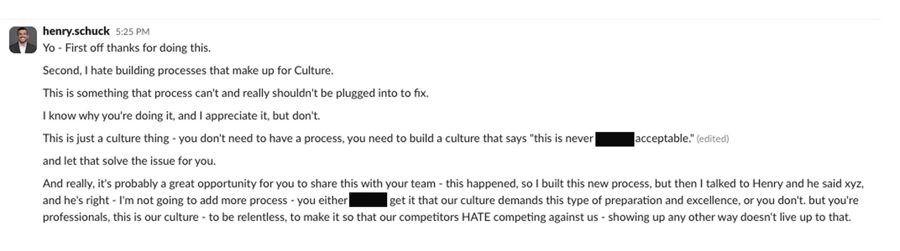
You CANNOT fix CULTURE with PROCESS.
Earlier this year, one of my sales managers slacked me a new Google Form. Every sales engineer (SE) would have to fill it out before every customer call. FOREVER.
I get why he created it.
A rep on his team showed up to a call the prior week unprepared. The SE was there too, just as unprepared. He spent the call asking the customer questions we should have known the answers to before we ever dialed in.
They wasted the customer's time.
So he did what most managers would do: "I'm going to create a process so this never happens again - so now before an SE or an AM gets on a call to show the product, they have to fill out this form."
Then he spent his Saturday - his Saturday - building a 14-question intake form. Required for every SE. Before every customer call. FOREVER.
That is not the answer. You don’t fix unprepared reps with a form.
You build a culture where nobody shows up unprepared in the first place.
Every process you add is a TAX.
And you CHARGE that tax to every person on your team who never had the problem - every day, forever - to fix the one person who shouldn't have been there in the first place.
Stack enough of those and you end up with processes on top of processes and everything slows down.
Some processes are worth the tax. Most aren't. This one wasn’t, so I told him to kill the form and do this instead:
Before you build a process, say the standard OUT LOUD.
Get the team on a call, tell them what happened and tell them what the standard is.
In our case: “Competing with ZoomInfo should be a DAUNTING experience for ANY of our competitors. This is NEVER acceptable. Showing up unprepared to a customer call doesn't live up to that. Full stop.”
Point back to that standard every time someone misses it. Let the people who can't meet it self-select out.
Manager: "But Henry, what if it happens again?"
Then it happens again. And you have the conversation again. Louder this time.
Process fixes broken systems - it doesn’t fix broken standards. Start with the standards.
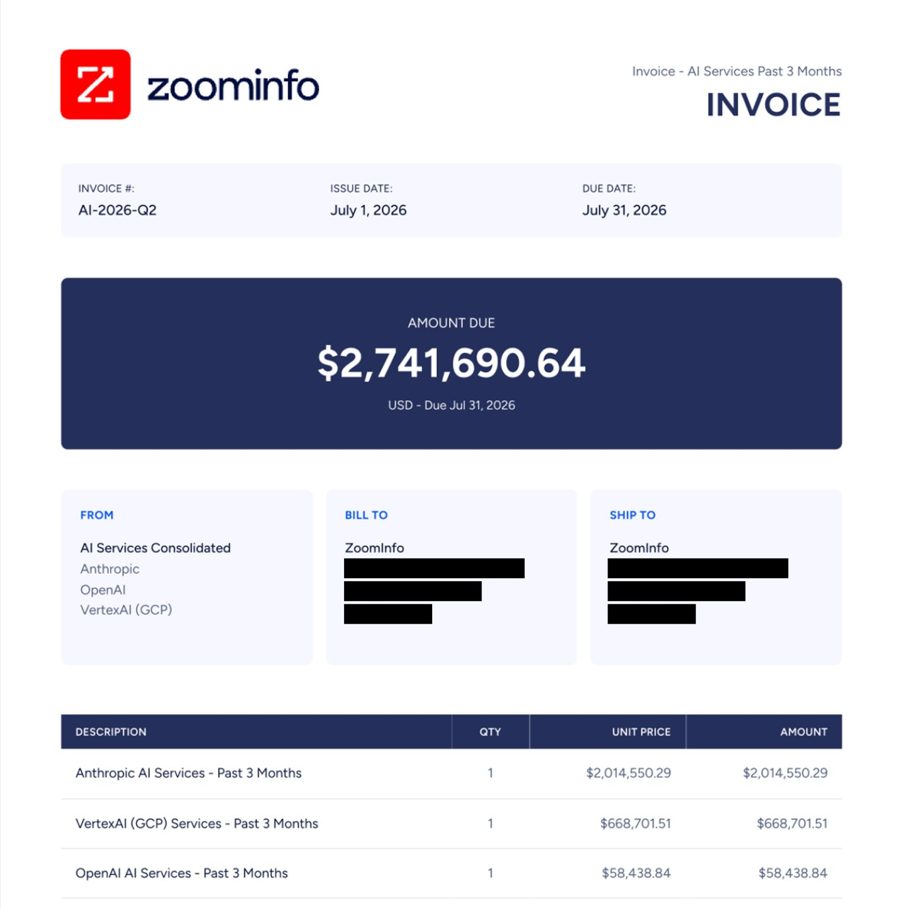
In Q2, our internal AI costs hit $2,741,691 - an ALL-TIME HIGH - so we made 5 changes to get it under control:
We noticed spend accelerating in March, right when the frontier labs stopped cutting inference prices and in some cases raised them.
At the same time our team at ZoomInfo was on a mission to become AI-forward.
We’d built 9,000+ agents but most requests were going to the most expensive models by default, and there was limited visibility into where spend was going.
The biggest piece we directly control is Mesh, our internal AI platform that our 2,700-person team uses every day. Inference there peaked at $255K in May - we reduced it by 46% to $137K in August.
We did 5 things to cut our token bill:
1. Attribute every dollar to tasks, not tokens
If you can’t trace spend back to a user, an agent, a department, or an automation - you can’t fix it. So we stopped measuring tokens and monthly totals and started measuring the cost per task.
We then worked out what it should cost to qualify an inbound lead, research an account, write the talk track and get it to the rep before their call etc. That went down as “good spend.”
Then we identified “bad spend” coming from things like duplicate and unmaintained agents.
2. Build an internal model router
Frontier AI is INSANELY powerful but most of what business users ask for doesn’t need it. You don’t need Fable 5.1 max effort to proofread an email.
We built our own router that classifies every request in Mesh as "frontier," "balanced," or "fast" so it gets sent to the right model across Anthropic, OpenAI, Gemini and Open-source.
3. Audit your agents, then automate the audit
1,000s of automated schedules were running on 9,000 agents - some of them were stale, unmaintained or duplicates, and they were running up the bill.
We cleaned house, then automated the audit so it runs in the background. Owners of high-cost agents now get a Slack message every week.
4. Compress the context
Most people don’t realize that a model re-reading context is the biggest driver of token spend. Long chats get expensive FAST, because the model re-reads the whole conversation every time.
We updated Mesh so it now reminds you to compress context at 25% and 50% of the context window. At 75%, it does it for you.
5. Put the cost in front of everyone
Every IC, manager and leader can see what their own AI usage costs, and a weekly spend report goes to every department lead. We don't cap anyone’s AI spend by default.
If someone crosses $1,000 in a month they're temporarily capped and an alert goes to the Mesh team and their manager. This helps business users think about efficiency the way our engineers already do.
3 months later and Mesh costs about half of what it did in May. The same 2,700+ people use it every day, and we can keep doubling down on AI across the business with a MUCH better return on every token spent.
If you've cut your AI spend WITHOUT cutting its impact, let me know what worked below. 👇🏽
Most AI workflows in GTM produce garbage.
The hype is EXHAUSTING: MCPs, CLIs, RAG, A2A. But to REALLY get AI working in GTM you need these 4 things:
1. Entity resolution
Open the CRM of any company at scale and search "Cisco." You'll get 20 records: Cisco, Cisco Systems, Cisco WebEx, Cisco AppDynamics. Which one is real?? Which contacts belong where??
If you don't know, your agent doesn't know either. It just picks one and is likely to make a mistake.
2. Hierarchy resolution
I spoke to a GTM team that launched a 20% off promo to "non-customers."
They only realized POST launch they’d offered the 20% discount to HUNDREDS of existing customers instead. Account managers were screaming at marketing but by then it was too late.
When they saw the list, the team realized: “oh wait, Uber Freight is a subsidiary of Uber…” Subsidiaries hadn’t been rolled up correctly so revenue got lost.
3. 1st-party and 3rd-party data stitched together for EACH account
Calls, emails, product usage, opportunity history. All of it has to be connected to the correctly resolved account, or your agent is writing account plans about the wrong company!
If it sees “Nvidia” transcribed as “In Video” or a press release about “Block, Inc” when your CRM says “Square,” your agent is operating blind. Every recommendation downstream is flawed.
4. Metadata an agent can read
Palantir popularized the term “ontology.” If an LLM doesn't know what a column means, it will give you a very confident (but wrong) answer.
If your data doesn't describe itself, you're asking the model to guess.
GTM has an ontology, it has accounts, leads, contacts, signals, champions, detractors, security review and procurement. Your GTM should work on top of a tuned model that should understand that.

Adam Schoenfeld recently called “GTM Context” the new vendor battleground.
The next era of GTM won't be won by who builds the most sophisticated precision demand workbook and campaign.
It will be won by who builds GTM context, and then let's agents and humans run an endless number of motions on top of that.
Right now, though, we think our GTM context lives in CRM - and CRM is a mess.
Your CRM has Google and Waymo as separate accounts, with no link to Alphabet Inc.
SpaceX acquires Cursor, but your account hierarchy never changes.
Travis Kalanick runs CloudKitchens now. Oh yeah, CloudKitchens is now part of Atoms.
Your marketing system still has him at Uber.
It doesn't matter how much inference and cognition you have - those linkages don't exist without a reference dataset - hierarchies and subsidiaries, employment histories, rebrands - everything constantly in motion.
A context graph is the missing layer beneath AI. It connects entities, history and activity, so GTM teams and agents work from the full picture instead of isolated records.
EVERY function that runs on AI needs one.
Legal has Harvey and Legora.
Engineering has Atlassian
Enterprise search has Glean and Dust.
We've spent the last two years building so that now, GTM has ZoomInfo
https://lnkd.in/g4H-P582
How do you lose the trust of your CEO?
Trust is an interesting word. Most people think breaking it only means lying but it's not that simple. There are 3 ways to break it:
1. You lie to me.
Yep, you guessed it. This one's the easiest of the three. There’s no coming back from it.
2. You're no longer competent.
This one’s a lot harder. Maybe they were great when I hired them. Maybe they were great for YEARS. But losing trust in your ability to do the job NOW is a form of trust-breaking too.
Wins over time build up a lot of credit. BUT I can’t keep sending you up to bat when your last home run in ‘20.
3. You recommend what’s good for you over what’s good for the company.
The jersey has the company name on the front and your name on the back. When someone flips that order and brings me ideas that are better for them, their department, or their career than it is for the company, I start questioning their motives.
That’s the worst position you can put a CEO in because now, every time you speak I have to run it through a spin cycle: is this good for ZoomInfo, or good for you?
NONE of us have time for that.
I need to believe that every recommendation from my team comes after deep thought about what’s best for ZoomInfo. That's how we succeed as a team.