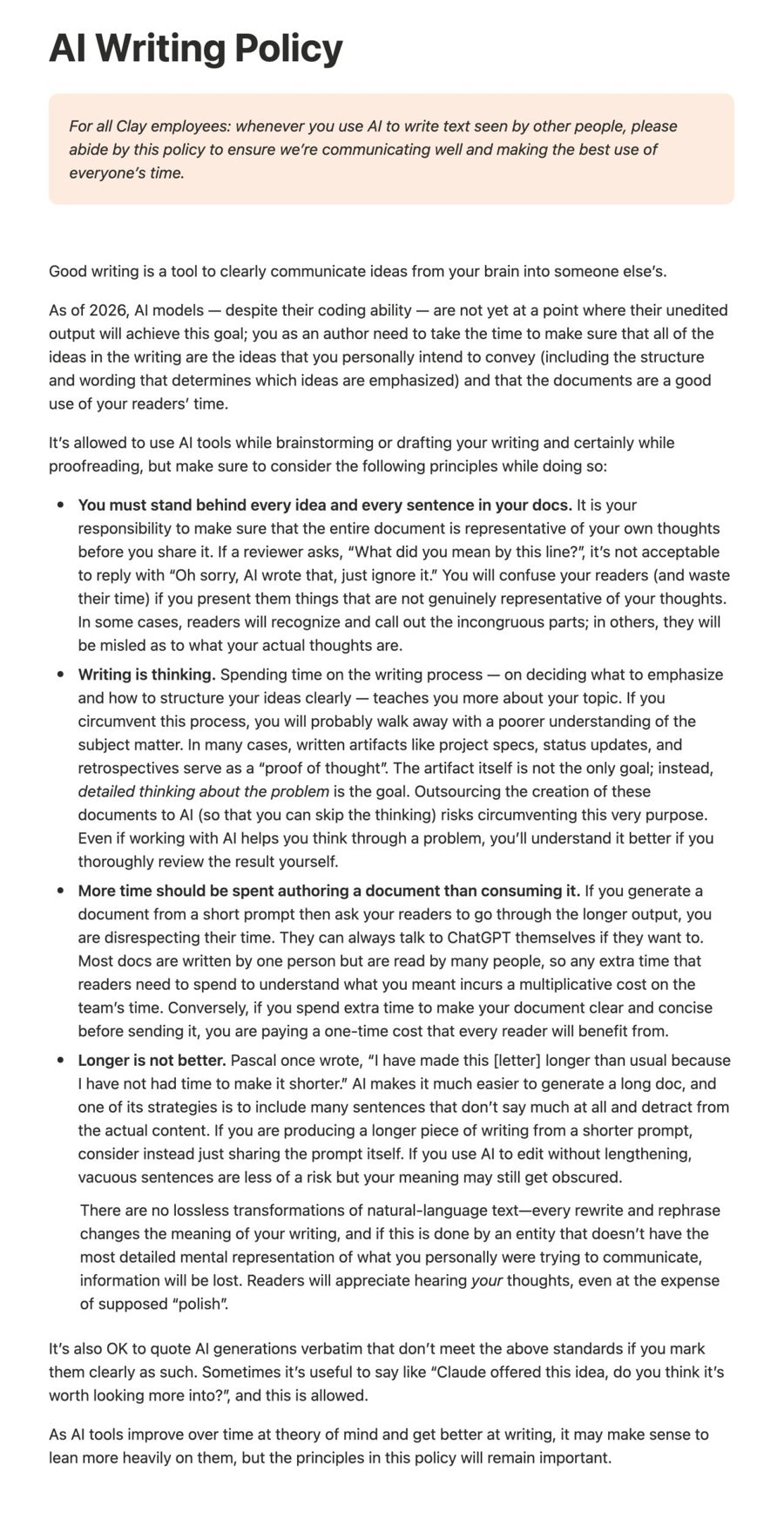
We just instituted an official AI Writing Policy at Clay. Massive thanks to Sophie Alpert on our engineering team who wrote this. Originally this was just for eng, but other teams found it so helpful we expanded it company-wide. Here are the four guiding principles:
1. You must stand behind every idea and sentence
It is your responsibility to make sure that the entire document is representative of your own thoughts before you share it.
2. Writing is thinking
Spending time on the writing process teaches you more about your topic. If you circumvent this process, you will walk away with a poorer understanding of the subject matter.
3. More time should be spent writing a document than consuming it
If you generate a document from a short prompt then ask your readers to go through the longer output, you are disrespecting their time. They can talk to ChatGPT themselves if they want to.
4. Longer is not better
AI makes it easy to generate long docs, and it loves padding them with sentences that say nothing. If you're producing docs from a short prompt, consider just sharing the prompt.
You can read (and borrow) the full policy below. Hopefully we all communicate a bit more clearly now :)
I interviewed every person we hired at Clay in my orgs until we passed 300 people. We're scaling beyond that now, so our recruiting ops team built a system that keeps me involved in every hire.
Here's how it works:
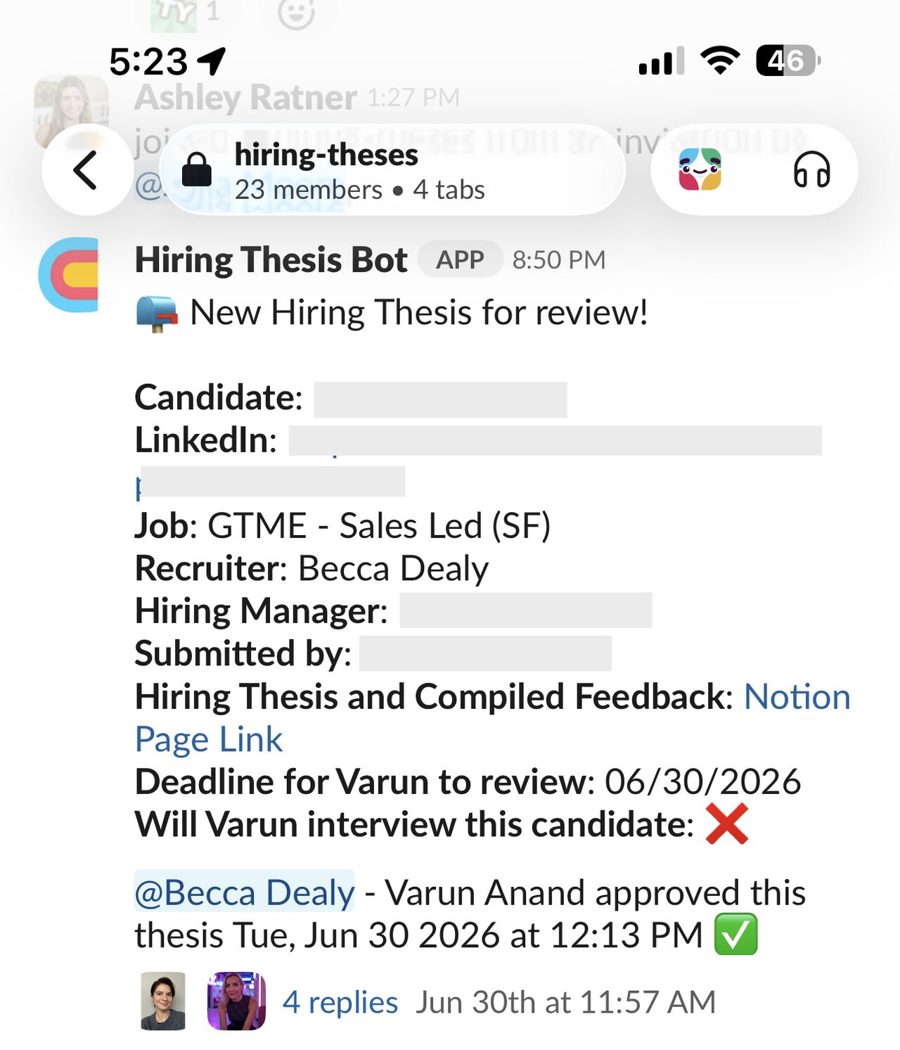
We have a Slack channel called hiring-theses. I keep it pinned at the very top of my Slack and I review it every day.
Before we hire anyone, the hiring manager writes a hiring thesis about the candidate. It answers four questions:
1. Why should we hire this person?
2. What is one exceptional thing this candidate has accomplished in their career or otherwise?
3. What are the risks/concerns?
4. How will we support this person if they join?
These are not one-line answers. A thesis draws on a deep dive interview into the candidate's whole story, behavioral interviews, scored feedback from every round, and thorough reference calls. The thesis also includes every piece of submitted interviewer feedback. When I review that feedback, I notice discrepancies, pieces of feedback from an interviewer that the hiring manager didn't address, or missing voices I want to hear from.
When a thesis is submitted, a Slack bot (built by Ryan Ellis) posts it to the channel with the candidate's name, Linkedin, role, a link to the full thesis document and a deadline for me to review. Then I approve, deny or discuss with the hiring team.
I can't sit in every interview anymore. But I still read every thesis and every piece of feedback before someone joins Clay. It's the closest thing I can do to being in the room.
Hopefully this is helpful to other teams scaling past the point where a founder can meet every candidate.
Let me know if you have any questions!
Big update! TAM sourcing in Clay is now faster, more credit-friendly, and always-on.
Here's what you need to know.
1. Search finds your TAM quicker, with less credit waste.
Before, if you wanted to find “companies in Europe with 50+ engineers” you had to pull ~16M companies in Europe, split them into ~350 tables (because of tables’ 50k row limit), then enrich to filter down to the ~4k companies with 50+ engineers. It took hours and cost 1 credit per row (so in this case, 16M credits!).
Now, you can describe your ICP once in natural language across companies, people, and jobs. The same example takes just a few minutes to find the ~4k relevant companies for ~98% fewer credits. You can run the same search from Clay or with our CLI in Claude or ChatGPT.
2. Reporting in Audiences shows if your sourcing is converting.
Measure the pipeline and revenue tied to the data you source in Clay, so you can learn from what’s working. See which of the 4k companies converted, and identify trends to better refine your ICP.
3. Lookalikes finds more leads like your best customers.
Input a list of up to 15,000 of your best customers. Clay clusters them into data-driven groups and builds a continuous search for more accounts like them.
Put it together and TAM sourcing becomes a loop: source the right accounts, see what converts, then go find more like them.
Read the blog here: clay.link/3QAfBZD
Account Agents are now live in Clay! To show you how it works, we’re taking you to one of the last old chess parlors in Greenwich Village.
If you're in sales or marketing, what you already know about an account should decide how you respond to it. A demo request from a company that trialed you last quarter shouldn't be handled like one from a company that's never heard of you. One goes straight to the AE who knows what stalled. The other starts at qualification.
The problem is you write automation rules before you know which accounts will hit them. The account's real history sits in your CRM and Gong calls until a rep digs it out.
Account Agents put that history inside the play. Drop one into any workflow as a node and it arrives knowing every touch, call, deal, and past conclusion on the account. You draw the possible paths when you build the play. When a trigger fires, the agent picks which action to take and the Workflow runs it. What the agent learns gets saved back to Audiences, so your plays get smarter with every run.
Account Agents in Workflows are in open beta for Enterprise, Growth, and Launch customers.
Learn more here: clay.link/KOzBbjh
How does this relate to chess? I’ll let Mishti explain it 👇