Our new product, Clay Ads, is officially live! In two months, our growth team dropped LinkedIn CPL from $250 to $25. Here's how:
Exclusion lists that auto-sync to Salesforce so ads only reach people who can actually buy. If you’re an existing customer, open opp, or partner, you won’t see our ads. This is by design!
Meta became a real B2B channel for us too. Work emails rarely match personal profiles, so most B2B teams skip it entirely. Clay enriches contacts with personal emails before audiences ever hit the platform. 60%+ match rates. And one recent campaign generated 200 leads at $10 each within 24 hours.
And the audiences stay fresh on their own. When someone becomes a customer, they stop seeing your ads the next day. When sales shifts priorities, targeting shifts with them. This all happens automatically, across both platforms.
No CSV exports or manual rebuilds.
We're hosting a live workshop tomorrow showing exactly how we built it! Link below :)
My mom taught me that if you get bad news or get disappointed, you should metabolize any anger or other difficult emotions first so that you can have a calm, considered conversation and not harm others.
One time in high school I crashed her car. I was terrified to tell her, but when I did, she just reacted calmly, and talked me through what we could do to fix it. She taught me that I should avoid being reactive in the moment and because of that I continued to trust her and tell her the truth. Because I knew she could hold it and help me rather than become an additional burden I have to manage.
This is a lesson I’ve tried to take with me in my work. My co-founder Varun Anand told me recently that he always feels comfortable coming to me with hard problems because he knows he'll walk away feeling connected and that we'll find a way forward. I try to encourage everyone at Clay to approach problems this way: without anchoring on what you think is right and with a simple commitment to arrive at an understanding together.
I shared some appreciation for my mom in this video with First Round Capital.
Happy Mother’s Day to her and all the great moms out there. Thank you for loving us even when we accidentally crash your cars :)
We are growing incredibly quickly and more than doubling our headcount this year. The main reason we can do this is the productivity gains we get from running as an AI First company. Building with AI tools is a big part of that.
Here are three things we built with Anthropic models that have let me scale the company quickly:
1. We built an agent that handles 100% of bug triage, from first pass to suggesting code changes for fixes. In the last 2 months, it has amounted to solving exponentially more bugs autonomously, with the domain of issues it can tackle growing by the day. We estimate it saves significant engineering time each week.
2. We built an analytics agent powered by Opus to enable self-serve analytics at scale. The data team is no longer the bottleneck for insight extraction. Anyone can ask Monty an analytical question directly from Slack, and it will write and run the SQL to answer it, with built-in guardrails that guarantee trustworthy, accurate insights from our data in Snowflake.
3. We built a suite of engineering management tools to make sure our engineers are always supported and unblocked on the projects that matter most. Engineers spend less time managing up and sending progress reports because Claude lets us understand, aggregate, and synthesize the ground truth, looking directly at commits and what's shipped.
Tools like Claude Code have also changed how we de-risk new products. For three upcoming products, we had one person build a demo-able version in 1-2 weeks. That was enough to validate the product surface area and give us the confidence to put real resources behind it. We then spent a few months perfecting it for release. This lets us figure out what's worth building and decrease risk much faster.
I've focused on scaling both my own and the team's ability to make decisions faster: understanding what customers want, building it for them, and having real-time visibility into what's shipping and how the business is performing. We're just getting started.
As for what product releases are upcoming, you'll have to wait and see :)
One of our biggest differentiators at Clay is that we take seriously what most people don't.
At most companies, content, brand, editorial, and other arts-oriented roles have traditionally been treated as optional functions, downstream of where the "real" work happens. That is not how we operate.
We are a fundamentally creative company. Many of us study music, paint, write, or make films outside of work. We often start All Hands with a poem. We respect the work of storytelling — in every medium — and we want to incentivize the world's best people to do it here.
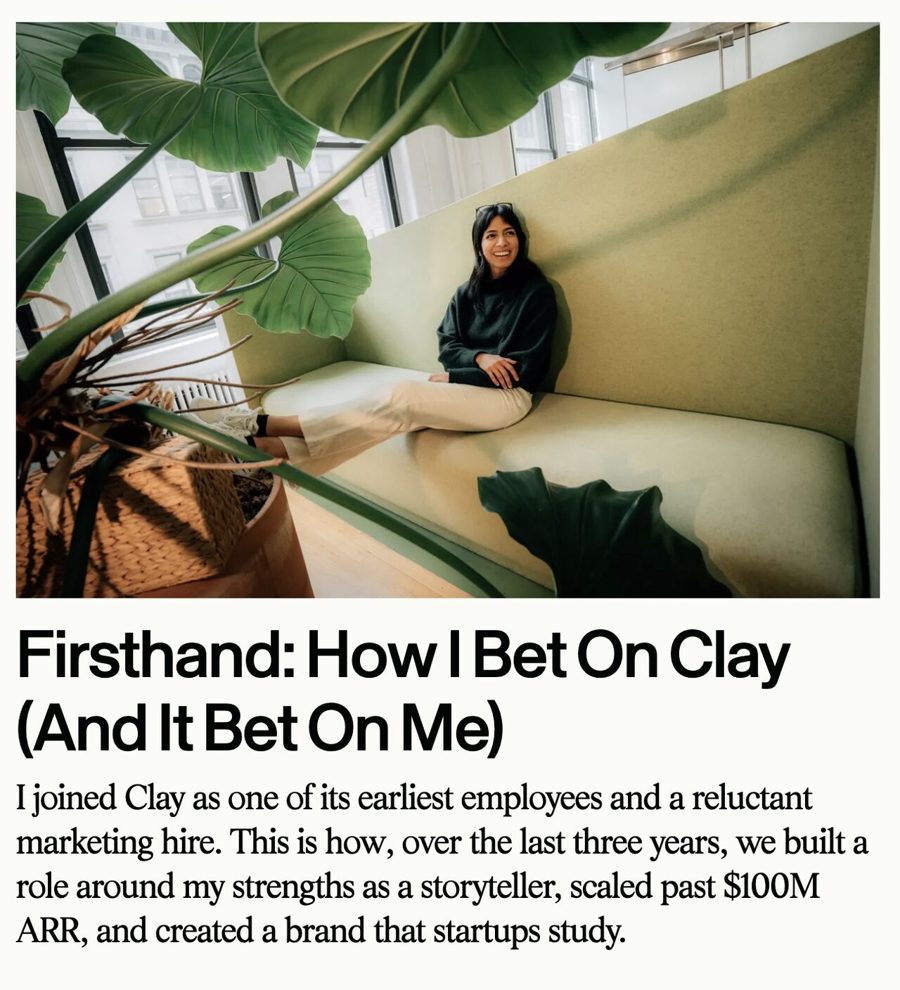
Mishti Sharma's story is a case study in this. When we met three years ago, she was reluctant to lean into her strengths and try a narrative role for the first time. It made sense: she was used to professional systems that don't respect or reward that work.
But I've always seen companies as a collection of points of view. The words and images a teams chooses for what it's building shape how the world actually understands what they do, and I take that work seriously.
So we spent the next few years co-creating the perfect job for Mishti — now our Head of Narratives — and she's since penned most of the words and frameworks that explain Clay to the world, from our major announcements to GTM engineering or GTM Alpha. Those frameworks are now used across the industry, with thousands of GTM engineer roles posted each quarter at companies like Webflow, Notion, and Canva.
For the full story, read Mishti's piece for First Round Capital's debut Firsthand series about her journey leaning into a role that felt at home here. It's the most behind-the-scenes story of Clay yet: https://lnkd.in/e4Xx9CNp
Today we’re updating Clay's pricing. We’re anxious (pricing changes are scary) but we are doing it because we genuinely believe it’s better in the long term for our customers and us.
Our goal is to have Clay be your default tool for GTM Engineering. Data is the fuel of GTM teams. So we want to decrease the cost of data in Clay so you use it more. We also need to align our incentives so that you use Clay as the central hub for every GTM tactic, not just data enrichment. That means we should capture a portion of the value that we provide when you orchestrate data in Clay.
We’re introducing changes that implement this:
-We are reducing data costs dramatically in our marketplace between 50-90%
-Introducing Actions and Data Credits which separate platform work and data and costs so you can have a clearer picture of what you are spending on
-Simplifying and improving the value of our plans
Credits are now Data Credits, and we’re introducing Actions to measure platform work. We've designed plans so 90% of customers will never hit a limit on Actions. For power users who do reach an Action limit, you can upgrade to the next Action tier without upgrading your plan.
Actions cover the orchestration: the workflows, AI research, and automation that turn raw data into GTM motion - we count this whether or not you use our data credits. 90% of customers will never hit their limit. We'll be announcing more features in the coming months, like self-improving agents that help teams find and grow their best customers.
We are removing the middle tier plan because we found that most people either downgrade or upgrade to Pro after a few months. We are reducing the price of the Pro plan and renaming it to Growth and adding more features in it.
A few other things worth knowing: existing self-serve customers get to choose whether to move over or stay on legacy plans. And if the new pricing saves you money, we'll reach out and tell you.
As always we believe that growth is creative and not just operational, and Clay is the best place to actualize that.
You can read the full pricing announcement we sent our team here: https://lnkd.in/evEjm5T4