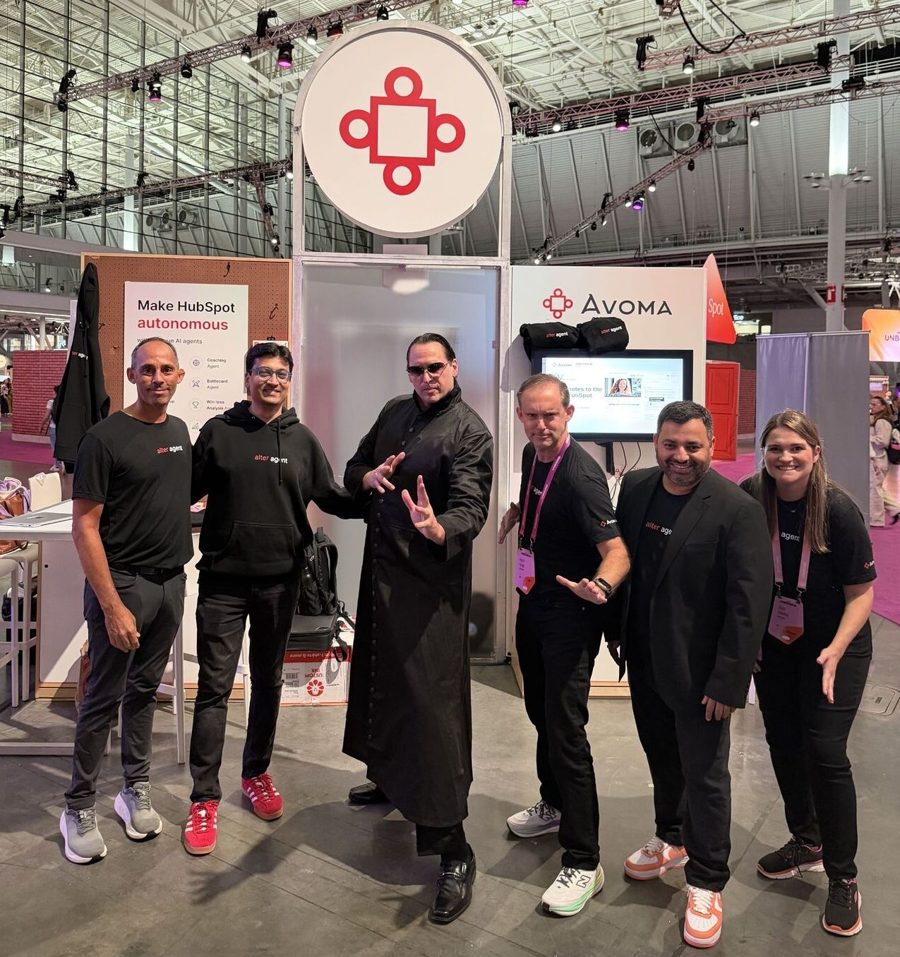
The best thing we brought back from HubSpot's UNBOUND wasn’t just the millions of dollars in pipeline.
It was what happened to our team.
I’ve always thought about conferences in terms of customers, pipeline, partnerships, and brand.
But this week reminded me there’s another ROI that’s much harder to measure.
A conference gives your entire team one common goal.
For weeks, everyone is thinking about the same questions:
How do we stand out?
What should we launch?
What story should we tell?
What experiments should we run?
How do we create something people remember?
Marketing, sales, product, design, and leadership suddenly start solving the same problem together.
And that unlocks creativity.
Ideas that might take weeks of meetings happen in 15-minute conversations at the booth. Someone notices something. Someone builds on it. A few hours later, you’re trying it.
Then the conference itself becomes a massive learning exercise.
You meet hundreds of customers, prospects, partners, founders, and other interesting people.
You learn what buyers actually care about.
You watch competitors and other vendors. How they position. How they tell their story. What attracts people and what gets ignored.
You attend sessions that give you tactical ideas you can use next week, and others that change how you think about building a company, leadership, or the future.
And of course, not everything works.
Some of our experiments didn’t work as planned. There were things we should have planned much better.
But that’s part of it.
When enough things work really well, nobody sees the experiments that failed behind the scenes.
You learn, adjust, and move on.
But my favorite part was even simpler.
Spending genuine time with the team.
Breakfasts. Walking around together. Late dinners. Random conversations between meetings.
You learn about people’s families, ambitions, struggles, and lives outside work.
And that creates a different level of trust.
So yes, we came back with millions of dollars in pipeline.
But we also came back with new ideas, new relationships, better market understanding, stronger alignment, and a team that knows each other a little better.
I’m incredibly grateful for everyone who made this week happen.
Maybe the biggest ROI of a conference isn’t what your team brings back.
𝗜𝘁’𝘀 𝘄𝗵𝗼 𝘆𝗼𝘂𝗿 𝘁𝗲𝗮𝗺 𝗯𝗲𝗰𝗼𝗺𝗲𝘀 𝗮𝗳𝘁𝗲𝗿 𝗴𝗼𝗶𝗻𝗴 𝘁𝗵𝗿𝗼𝘂𝗴𝗵 𝗶𝘁 𝘁𝗼𝗴𝗲𝘁𝗵𝗲𝗿.
Already looking forward to next year's UNBOUND. 🙌
Apparently, every time a frontier AI company launches a new feature, an entire SaaS category is supposed to die. 🙄
Claude launches Claude Code?
RIP AI coding platforms.
ChatGPT launches Sora?
RIP AI video creation platforms.
Claude launches meeting notes?
RIP meeting note-taker apps.
ChatGPT launches sales tools?
RIP CRM software.
At this rate, we should probably just shut down every SaaS company and give everyone Claude or ChatGPT. 😂
Except... that's not how customers actually buy software.
Think about AI coding.
Claude Code is incredibly powerful.
Yet products like Lovable and Replit have built $500M+ ARR businesses by making software creation accessible to different kinds of users.
Why?
Because not everyone wants flexibility and control, or wants to become an AI coding expert with Claude.
Some people want simplicity and a finished product that works out of the box. 😇
They don't want to figure out prompts, infrastructure, deployments, integrations, permissions, and every other technical detail. 😵💫
They just want to build something.
The same thing is happening with AI note-taking in the revenue tech space.
Yes, Claude can take notes.
So can Zoom, Google, Microsoft, and probably your toaster by next Tuesday.
But taking notes is ONE capability.
It's not the entire workflow.
For revenue teams, the real work involves connecting context across meetings, emails, CRM, and other systems.
It involves governance, access controls, privacy, collaboration, coaching, pipeline inspection, forecasting, and execution.
And different customers will always have different needs.
Some will be perfectly happy with a basic note-taker built into their existing software.
Others will need a purpose-built workspace where their teams and AI agents can actually get work done.
Both are valid.
As a founder building in this category, I actually welcome the commoditization of basic capabilities.
AI will commoditize features much faster than it commoditizes complete workflows.
Because when everyone can generate the same output, the differentiation moves somewhere more interesting.
The biggest opportunity is building software where customers don't have to figure out how to make AI do everything.
Apparently, everything is an AI agent now. 🙄
AI summarizes your meeting? Agent.
AI drafts an email? Agent.
AI researches an account? Agent.
AI sends a Slack alert? Agent.
AI updates a CRM field? Agent.
At this rate, even my calendar reminder deserves an agent badge. 😂
Don't get me wrong. These are useful capabilities.
But many of them are simply workflow automations, AI-powered features, or intelligent notifications.
We've had automation for decades.
Adding an LLM to an existing workflow doesn't automatically make it an autonomous agent.
To me, a true AI agent should be able to understand a goal, reason about what needs to happen, take actions, adapt based on results, and work toward an outcome. 🤖
Not every agent needs to be fully autonomous. Some should absolutely require human approval.
But there's a meaningful difference between executing a predefined task and independently figuring out how to achieve a goal.
And I think we're losing that distinction in all the AI hype.
If everything is an agent, eventually the word means nothing.
Are we genuinely building AI agents, or just rebranding automations we've had for years? 🧐