Today we're launching Computer Use for the Vanta Agent. Of the 650,000 images uploaded to Vanta in the past six months, 36% were screenshots because evidence and control monitoring outside an API required as much. The Vanta Agent can now use a computer to capture screenshots with scoped access, one-click approval, and a full record of every artifact created.
Screenshot evidence collection has been one of our biggest requests, and we couldn't have built it until recently. The last couple of months have been all about finding the jagged edge of AI capabilities and translating it to our customers.
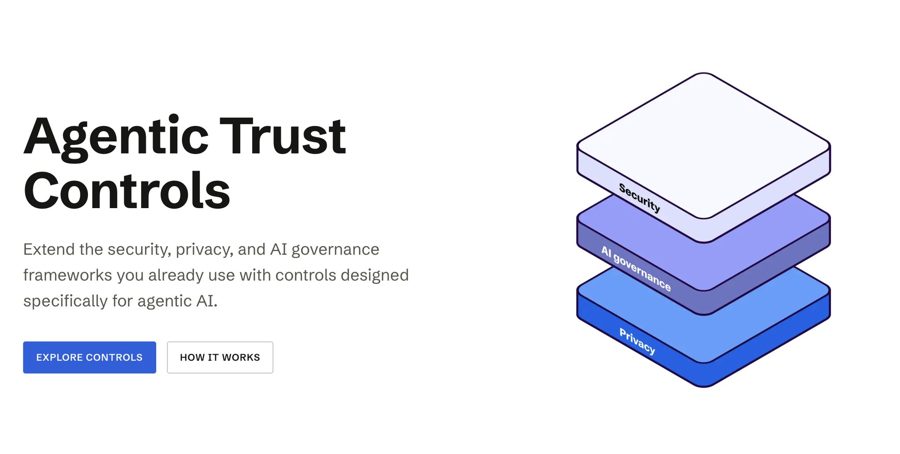
🚢🚢🚢 This week, we open-sourced Agentic Trust Controls: 61 controls across 12 domains that security, privacy, GRC, and AI teams can use to evaluate and improve agentic AI systems.
The problem it solves: companies are adopting AI agents fast, but how does one know an agent is trustworthy and secure? There's neither a shared framework nor a practical starting point for governing agents.
We are well-versed in XKCD 927 at Vanta, and we are not trying to introduce a new standard.
Instead, ISO 27001 and ISO 42001 are strong foundations, but they were never meant to cover every technology and instead expect you to define additional controls for your own risks. Agentic Trust Controls can be those additional controls.
We split the control set into two user archetypes:
• Developer: 40 controls for teams building agents, e.g. identity and authority, action guardrails, memory protection, instruction integrity, adversarial testing, and runtime instrumentation
• User: 21 controls for teams deploying agents built by others, e.g. intake and inventory, credential control, oversight staffing, vendor review, runtime monitoring, and staff training
We don't think any single company should get to define what trustworthy AI governance looks like. Instead, we believe real AI Governance standards will come from the people building, securing, auditing, and governing agentic systems.
If you're working on agents, we'd really like your feedback and your contributions. Link in the comments. What controls do you want to see?
For awhile now, we've had a running joke at Vanta that we wish we could clone Jan Castor. (If you've worked with Jan, you get it.)
So Jan took the joke literally.
He started with code review, which he was uniquely excellent at (strong instincts + Vanta context) and took a lot of time. He started by training an agent (JanBot) on two years of his PR reviews. To avoid over-fitting, he added in reviews from other Vanta engineers whose judgement he trusted. In doing so, the agent became excellent at several things: naming, mechanics, the feature's shape. Jan claims the clone's better than him now, but those of who work with Jan still prefer the real deal.
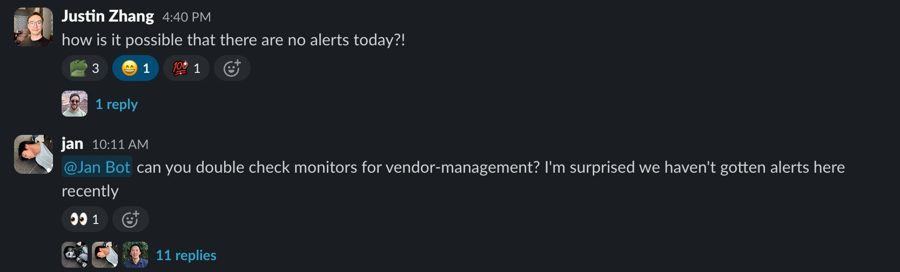
Anyway, when JanBot took over Jan's PRs, real Jan spent more time on on-call, so he started training JanBot on that, in Slack, and JanBot started triaging alerts -- so many that Justin Zhang thought something had broken. (Jan did too.) Turns out JanBot had been on the case!
No one told Jan to "scale himself" or "build in an AI native way." (What do those words even mean anyway?) Jan took the running joke seriously, built something that he wanted, and then iterated until he got to something that's changed all of our workflows at Vanta.
Thanks (real) Jan!
Link to Jan's full post in the comments.
Trust is the defining problem of the AI era.
And it can't be solved with a screenshot; a point-in-time check tells you so little. We need to move beyond that old world.
Our mission at Vanta is to help companies earn and prove trust. Compliance is part of that, but the real goal is trust that’s continuous: controls monitored 24x7x365, with monitoring, alerting, and fast remediation.
Dust is a great example of earning and proving trust in the AI era: Zeid M., their security engineer, connected the Vanta MCP to his own agents. Those agents now watch Dust's security and compliance posture constantly.
When a control drifts or a test flips, a Dust agent catches it, checks the control owner, looks into their work queue, preps a next step, and routes the gap + proposed fix to the right team. Zeid used to do this on his own -- looking out for drift, tracking down owners, nudging them before deadlines. Now he reviews and approves the high-stakes calls while his agents handle the rest. “We moved from reactive compliance work to preemptive security work," he said.
Trust in the AI era has to be always on and agent maintained, with humans making the calls that matter. Anything else is too slow.
Full story in the comments 👇
Our AI control-to-evidence mapping had been live for a bit before we found out how mediocre it was.
The feature suggests evidence to satisfy a given control, which is particularly important when customers import their own. It seemed fine: customers used it, no support tickets, business as usual.
Then, we built a proper offline eval and scored thousands of evidence suggestions across hundreds of control descriptions. It scored less than 35% precision. The model and harness were going too wide, with high recall and loads of suggestions (mostly wrong.)
We couldn't see the quality problem without measuring it, which led us to build an AI Quality Maturity Model:
1. Observability -- full trace coverage on every interaction
2. Eval datasets -- versioned, actively maintained, with real-world complexity
3. Calibrated evals -- formal LLM-as-judge pipelines calibrated with our GRC subject matter experts
4. Systematic experimentation -- repeatable loops to test changes
5. Integrated feedback loops -- explicit and implicit signal from real users
None of these dimensions are novel, but we learned they're the difference between AI that might work and AI that actually works.
Vanta has eight years of data on compliance audit outcomes, including specific matches between controls and evidence. It creates a flywheel.
Part of today's conventional wisdom is that if you have proprietary data about a vertical, go fine-tune a model on it. But when I talk to inference providers, their customers mostly fine-tune for cost and sometimes for style. Very very few companies fine tune to increase accuracy on hard problems.
We find proprietary data worth more as ground truth. Eight years of real audits -- what evidence passed, which was flagged, any iterations -- is how we define what good evidence looks like. We can calibrate our verifiers against real auditor judgement and hold a quality bar across them.
Anyone can prompt a model, but understanding output is much tougher.
We ride every model improvement for free, and each new model lands in a harness that no one else has, which improves our product. Here, a better product runs more evidence past more auditors, sharpening the verifier and improving the harness. The models keep getting better. Our data makes their outputs better. Each turn improves the next.