Understory ranks No. 140 on Inc. 5000 list of fastest-growing companies in U.S. Read more about Understory on the 2026 Inc. 5000 list

Tomer Weingarten

Tomer Weingarten

Co-founder & CEO at SentinelOne

Mountain View, California, United States · Cybersecurity · LinkedIn profile

Tomer Weingarten is Co-founder & CEO at SentinelOne, based in Mountain View. On LinkedIn Tomer writes mostly about company news and industry analysis, most often as posts with an image.

27K+followers
371reactions on a typical post
724reactions on the best post
3 of 29recent posts worth featuring

Tomer's best LinkedIn posts

Recent posts that drew 100 reactions or more and say something a peer would learn from, most reactions first. Click any post to open it on LinkedIn.

Tomer Weingarten
Tomer WeingartenCo-founder & CEO at SentinelOne
There’s been a lot of confusion following Anthropic’s launch of Claude Code Security. Let’s separate the reality from the noise and look at what is actually being disrupted. What did Anthropic actually release? Claude Code Security is a capable AI tool designed to read a developer's codebase, find vulnerabilities, and suggest fixes. It is incredibly impressive. The "Code to Cloud or Application Security" Illusion: Over the last few years, we watched a massive industry trend where major cybersecurity vendors were rushing to acquire tools to do exactly this. This category is known as Application Security. It is roughly a $20B market, which represents only about 5% of the total cybersecurity landscape. Major players spent billions acquiring their way into this space — CrowdStrike buying Bionic; Palo Alto Networks acquiring Bridgecrew and Cider, Dig and more; Wiz pushing to Code; alongside pure-play names like Checkmarx and Snyk. The reality is that many of these legacy, rule-based code-scanning tools are about to be commoditized. AI models like Claude are simply better, faster, and cheaper at reading and reasoning through static code. At SentinelOne, we intentionally chose not to acquire our way into this specific market. I have been vocal for the past few years that this exact segment was incredibly risky and ripe for AI disruption given AI’s code generation trajectory. More generally — the hope is code will be generated more securely from the get-go, with coding tools like OpenAI Codex, and Claude Code. So, what does this mean for the future of cybersecurity? AI will subsume certain cybersecurity features of disjointed platforms (built by acquiring legacy narrow feature acquisitions) — specifically those based on manual review, audits, and pattern matching. I suspect that cloud misconfiguration posture management (aka CSPM) could be ripe for disruption - even though it is more nuanced and less structured than code security, so might not be as straightforward. However, active, real-time, and autonomous defense against sophisticated threat actors remains a highly defensible core of cybersecurity. There is a massive difference between finding a bug in a static environment and stopping a live, adversarial cyberattack in real-time. Singularity was built on a fundamentally different premise: autonomous, AI-native security. We don't rely on manual audits or legacy pattern matching. Active, real-time defense against threat actors is only getting more critical. The vendors built on autonomous, AI-native architectures will leverage this moment to get even stronger. The platforms relying on legacy patchworks have a difficult road ahead. Speaking of that.. another super concerning LLM based cyberattack was uncovered: https://lnkd.in/gVYe_UGu

Image from Tomer Weingarten's LinkedIn post
Tomer Weingarten
Tomer WeingartenCo-founder & CEO at SentinelOne
Jensen Huang and I share the same conviction: AI changes what the computing stack must provide for its behavior to be trustworthy. In practice, that means a direct line between the agent runtime and the protected infrastructure beneath it, with visibility and enforceable control under every AI action. BlueField-4 and secure enclave architectures make it possible to secure the runtime from the hardware up, shrinking the surface that has to be defended down to the hardware boundary. Any AI, on any computer that supports it, gets safer by design. Today, you can't responsibly hand consequential work to an AI agent without knowing three things: what it's doing, whose authority it's acting on, and whether the limits on that authority actually hold. Those guarantees can't rest on assuming a model following instructions. We've watched that fail too many times. The safeguards have to be built into infrastructure itself. This is an important step, and there's more to build. Claims of trust have to be grounded in demonstrable behavior, and getting there will take sustained research and engineering across the stack. That is the work we at SentinelOne are committed to deliver. Congratulations to the NVIDIA team on the launch of the NVIDIA Open Agent Safety Program. This is how increasingly capable AI becomes governable, and how organizations get comfortable entrusting it with work that matters. Read more on my new blog 'The Endpoint': https://lnkd.in/g2PmwZqw
Tomer Weingarten
Tomer WeingartenCo-founder & CEO at SentinelOne
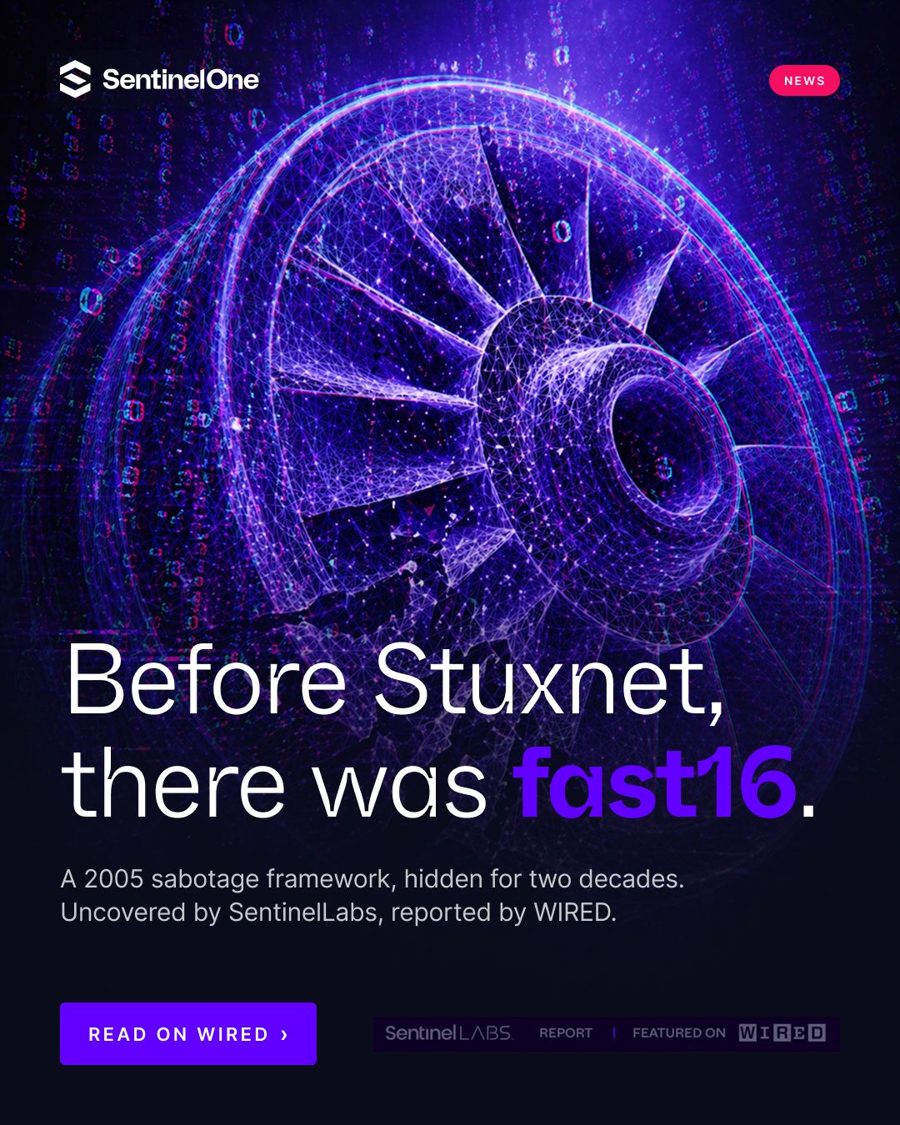
The name "fast16" appeared in the 2017 ShadowBrokers leak with one instruction to operators: "Nothing to see here — carry on." For twelve years, nobody knew what it was. Until now. "...the most subtle form of sabotage ever seen in an in-the-wild malware tool: By automatically spreading across networks and then silently manipulating computation processes in certain software applications that perform high-precision mathematical calculations and simulate physical phenomena, Fast16 can alter the results of those programs to cause failures that range from faulty research results to catastrophic damage to real-world equipment..." Tremendous work by Vitaly Kamluk and Juan Andres Guerrero-Saade (JAGS) to uncover fast16 — a cyber sabotage framework whose core components date to 2005. Five years before Stuxnet. The first of its kind. Read on WIRED: https://lnkd.in/geVNkZk9 Read the blog: https://lnkd.in/gaFGG_WB SentinelOne
Image from Tomer Weingarten's LinkedIn post

What Tomer posts about

  • Company news45%
  • Industry analysis28%
  • Team and hiring10%
  • Events and content7%
  • Customers3%
  • Advice and playbooks3%
  • Personal stories3%

What makes the best ones work

  • Most of Tomer's best posts open with a plain statement of a view.
  • 67% of them carry an image.
  • They run long, often past a thousand characters.

Questions about Tomer Weingarten

Who is Tomer Weingarten?

Tomer Weingarten is Co-founder & CEO at SentinelOne, based in Mountain View. On LinkedIn Tomer writes mostly about company news and industry analysis, most often as posts with an image.

What does Tomer Weingarten post about on LinkedIn?

Mostly company news, industry analysis and team and hiring. Of the 29 recent posts we read, 3 drew 100 reactions or more with real substance.

What is Tomer Weingarten's most popular recent LinkedIn post?

The one that opens “There’s been a lot of confusion following Anthropic’s launch of Claude Code Security. Let’s separate the reality from the noise and look at…”, with 724 reactions and 44 comments.

Every post belongs to Tomer Weingarten. Understory is not affiliated with Tomer Weingarten or SentinelOne. We read public LinkedIn posts to study what B2B leaders write and what their audiences respond to, and the bio is our own summary. If this is you and you would like the page changed or removed, email alex@understoryagency.com and we will do it.

More cybersecurity thought leaders

See every cybersecurity thought leader, or the ads SentinelOne runs.

Want posts like these on your profile

We ghostwrite LinkedIn posts for B2B founders and executives, in their own voice, and turn the audience into pipeline.