The most reacted recent post at each company, in full. Click any post to open it on LinkedIn.

I read Dario Amodei's essay calling on the labs to pace the frontier. Sam Altman agreed. The frontier will move at whatever speed it moves. The rest of the world will not slow down. Our job in the cybersecurity community is to make sure it moves securely and safely.
Here’s what I see from the front lines:
1. The unit of threat is no longer the hacker. It's an autonomous campaign. I call it the Agent-state. We see coordinated AI agents executing attack campaigns at machine speed.
2. Sophistication is dead as an attribution signal. AI gives every criminal and lone actor elite execution. Identity, infrastructure, and intent tell you who's behind an attack. Skill doesn't.
3. Runtime is the control point. Endpoints, cloud workloads, and SaaS are the battleground. Governance documents don't stop an agent in motion. Enforcement at machine speed does.
4. Every AI agent is a privileged identity. Least privilege, short-lived credentials, traceable actions, and a kill switch. Permissions never expand because an agent decides it needs more.
5. Defense has to be autonomous but also bounded. Machine-speed response, tiered by consequence, with humans owning the high-impact calls.
6. Every failed attack should make every defender smarter. Feed what we block back into detection, across customers and models, with privacy intact. This is what CrowdStrike and NVIDIA introduced with SafeMind: an agentic, always improving model and harness protection system built for defenders.
7. The AI industrial base is critical infrastructure: weights, training clusters, APIs. Call it what it is and protect it like it is.
Pacing what comes next doesn't secure what's already here. The credible path is to deploy with proof: board-level accountability for AI security, independent external red teaming, incident disclosure, secure defaults, and controls that work in production - not on paper. Anthropic and OpenAI just committed to embedding independent evaluators with employee-level access. CrowdStrike will bring what we see from the front lines to that table.
The ability for AI to act must be matched by the ability for defensive AI to stop the breach.
https://lnkd.in/ggY5edWX

Nearly six years ago, I joined Vanta as its first Product Marketer. Today, I’m stepping into the role of Chief Marketing Officer.
Back then, Vanta was still a seed-stage startup and I knew nothing about compliance. I would have pronounced SOC 2 “S-O-C-2” in my interview were it not for Anthony Maggio who corrected me before my first call with Christina (and shout out to Dasha Maggio who connected me to Vanta in the first place!)
In the six years since, I’ve moved up, down, and sideways. I always tried to choose the move that afforded the steepest learning curve, and that move always seemed to present itself at Vanta. As the company grew from a charmingly-nerdy, llama-obsessed startup into a $4.15B company with $300M in ARR (thank goodness for Stevie Case!!), my role shape shifted from PMM, to leading marketing, then Head of Product Marketing, then adding in Comms and Brand, then VP Revenue Marketing, leading company-wide AI transformation, and now CMO.
I’m of course proud of the work I’ve done over the years: we’ve repositioned Vanta 3 times, launched viral billboards, built out the largest conference for GRC professionals, and pioneered new forms of “debrandgen” aka brand performance advertising, to name a few accomplishments. Mostly, though, I’m proud of the team I got to do it alongside - insanely smart, humble, funny as hell marketers who take the craft more seriously than they take themselves.
Thank you to Christina Cacioppo who took a chance on me six years ago and has supported every reinvention since, and to our kind and killer leadership team: John McCauley Jeremy Epling and Stevie Case. And thanks to my mentor, friend, and now Vanta Advisor Scott Holden without whom I would feel far less confident in taking on this next challenge.
For the First Round Capital Review, I shared the story of how I got here, which is really the story of how Vanta has built a culture of trust and learning that makes constant reinvention possible: https://lnkd.in/gmX_wXRq

There’s been a lot of confusion following Anthropic’s launch of Claude Code Security. Let’s separate the reality from the noise and look at what is actually being disrupted.
What did Anthropic actually release? Claude Code Security is a capable AI tool designed to read a developer's codebase, find vulnerabilities, and suggest fixes. It is incredibly impressive.
The "Code to Cloud or Application Security" Illusion: Over the last few years, we watched a massive industry trend where major cybersecurity vendors were rushing to acquire tools to do exactly this. This category is known as Application Security. It is roughly a $20B market, which represents only about 5% of the total cybersecurity landscape.
Major players spent billions acquiring their way into this space — CrowdStrike buying Bionic; Palo Alto Networks acquiring Bridgecrew and Cider, Dig and more; Wiz pushing to Code; alongside pure-play names like Checkmarx and Snyk. The reality is that many of these legacy, rule-based code-scanning tools are about to be commoditized. AI models like Claude are simply better, faster, and cheaper at reading and reasoning through static code.
At SentinelOne, we intentionally chose not to acquire our way into this specific market. I have been vocal for the past few years that this exact segment was incredibly risky and ripe for AI disruption given AI’s code generation trajectory. More generally — the hope is code will be generated more securely from the get-go, with coding tools like OpenAI Codex, and Claude Code.
So, what does this mean for the future of cybersecurity? AI will subsume certain cybersecurity features of disjointed platforms (built by acquiring legacy narrow feature acquisitions) — specifically those based on manual review, audits, and pattern matching. I suspect that cloud misconfiguration posture management (aka CSPM) could be ripe for disruption - even though it is more nuanced and less structured than code security, so might not be as straightforward. However, active, real-time, and autonomous defense against sophisticated threat actors remains a highly defensible core of cybersecurity.
There is a massive difference between finding a bug in a static environment and stopping a live, adversarial cyberattack in real-time. Singularity was built on a fundamentally different premise: autonomous, AI-native security. We don't rely on manual audits or legacy pattern matching.
Active, real-time defense against threat actors is only getting more critical. The vendors built on autonomous, AI-native architectures will leverage this moment to get even stronger. The platforms relying on legacy patchworks have a difficult road ahead.
Speaking of that.. another super concerning LLM based cyberattack was uncovered: https://lnkd.in/gVYe_UGu


One of the best ways to understand a product is to use it yourself. At Okta, we’ve been customer zero for Okta for AI Agents, putting our own approach to agentic security to the test.
We’ve found that some of the most useful agents are super agents that work across systems and remove friction for employees. That’s the idea behind Dex, our orchestrating agent for IT, people, travel, and expense support.
And just like a person, Dex has an identity. It’s registered in Okta Universal Directory, giving us visibility and control over where it is, what it can access, and what it can do. Those are foundational questions behind the blueprint for the secure agentic enterprise.
Early results have been encouraging: Dex reached 25% internal adoption in just two weeks, has been scaling steadily since, and has already fielded more than 23,500 interactions.
We’ll have much more to share about securing AI agents at Oktane next week. Until then, read more about Dex, what we’ve learned, and how we’re keeping our own agentic rollouts secure: https://lnkd.in/ewrQR7kz

Bryan PalmaPresident & Chief Executive Officer at KnowBe4 AI will not take your job, but someone who knows AI will.
AI usage has increased ten-fold in the last few years, and those entering the workforce face a unique set of opportunities and challenges.
Here is my advice:
➖ Embrace AI and learn how to build it in your everyday habits.
➖ Develop a strong voice in your prompts because AI has a tendency to create sameness.
➖ Hone your editing skills. AI puts everyone in a “director” position since inputs require crafting, and outputs call for contextual review.
➖ Know what info can and cannot be fed to AI.
What did I miss? How should young professionals approach AI and opportunities in their career?

One of the best signs that Tailscale is becoming a platform is when someone integrates it without talking to us first.
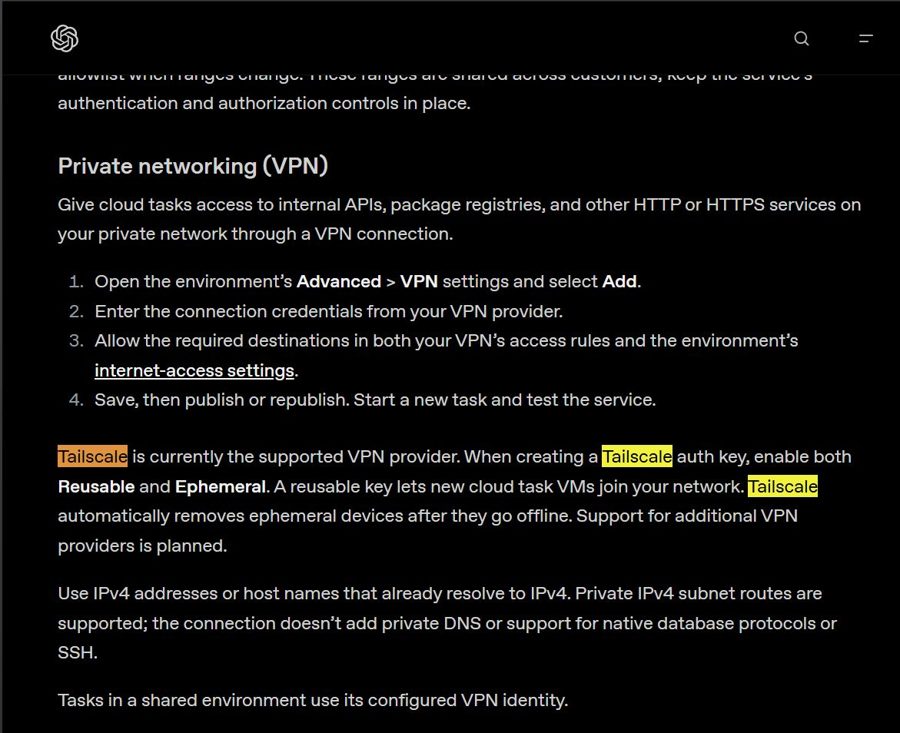
OpenAI built Codex in the cloud and added Tailscale as the supported VPN for private networking.
We didn’t know they were doing it.
There was no partnership agreement, custom API, or integration project. They just built it using the same Tailscale that everyone else gets. That’s how I want this stuff to work.
Good infrastructure gives you a few useful, stable pieces and gets out of the way. You shouldn’t need to call us before you can build something interesting on top of them. We’re seeing this more often now, with both companies and individual developers building Tailscale into things without needing us involved.
You can’t really decide to become a platform. You can make useful tools easy to build with, and if people start combining them into things you never planned for, the platform sort of happens on its own.
If you’ve built something where Tailscale is one of those invisible layers, I’d love to hear about it.
#platform #AI #VPN

In June, we gave every single employee at Tines access to build their own apps, agents, and automations using AI.
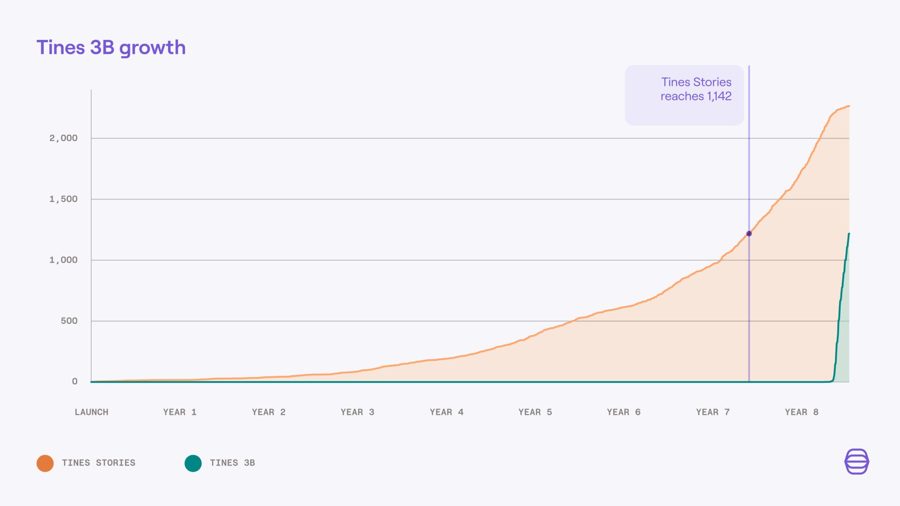
90 days later, we had over 1,000 employee-built workflows in production. 67% of people had built something. 100% had used something that someone else built.
For context, it took us 7 years to hit 1,000 workflows with Tines Stories. We hit that same number in 90 days with Tines 3B.
We're incredibly proud of how fast Tines Stories is, and how much value it brings our customers. But Tines 3B has accelerated that speed in a way we weren't expecting.
On paper, this is the kind of company-wide initiative that can create "wild code" - ungoverned AI building that threatens to blow through budgets and overwhelm the IT and security teams.
But Tines 3B gave everyone a safe, governed environment to build in from day one. Our IT and security teams approved the connectors, data, and systems people could touch, and continuous monitoring meant they never lost visibility or control over what was being built.
That's the trade-off most companies are still trying to figure out: how do you enable speed without losing control? We got a real answer from this experiment, and I think it's a really exciting first step in the journey.
Martin Moroney, our Director of Internal Automation, led this rollout and wrote about it on our blog - the wins, the challenges, and what's next. Read all about it: https://lnkd.in/dtMKiCDq
It’s been a wild 24hrs. There’s more to this on our blog https://lnkd.in/eC6nmMMc
Namely abuse of an additional ConnectWise M365 application (ConnectWise Cloud Management - MS Teams, Application ID 24205314-2b89-4e07-a2a4-579e898a5640) that gave itself Global Administrator and added credentials to multiple applications (including our single-tenant Huntress application unique to this partner's tenant).
Microsoft's sign-in logs recorded this second application connection coming from a private IPv6 address (ULA) fde4:8dba:2600:37ce:6d26:200:a76:*, a range Microsoft logs for traffic inside its own cloud network.
*I strongly suggest you audit your M365 environments for this immediately*

This week, I had the opportunity to ask a room of 100+ CISOs at Black Hat to raise their hand if they could confidently tell me how many AI agents are running inside their company right now.
One hand went up. I said, "I want to talk to you after this." I couldn't find him after and couldn't sleep last night wondering if they raised their hand because the answer is an easy "zero" or because they have solved something no one else in the room had.
That moment encapsulated the whole week for me. Black Hat 2026 was agentic AI, top to bottom.
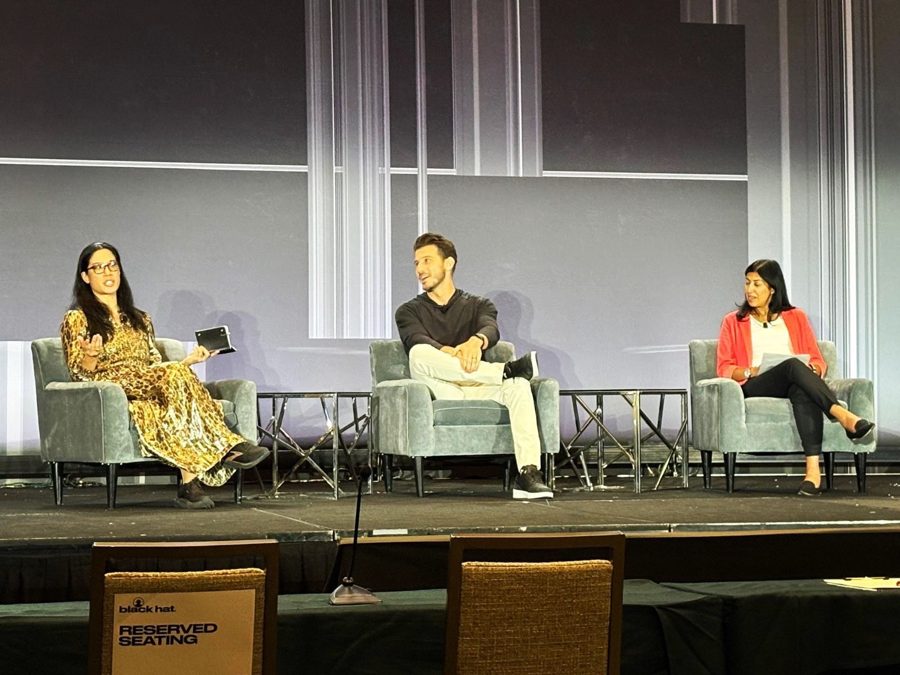
In my fireside chat with Avani D. and Caroline Wong, we got into an honest and respectful debate about where compliance audits stands today, and where the industry is headed because of AI. My bet is that the same continuous control monitoring that makes audit preparation faster and less painful will be table stakes in order to monitor AI agents over the coming year.
Then, in nearly every meeting with CISOs and partners, we talked about the same two themes: agent governance and third-party risk. Everyone needs to know what’s actually running inside the organization, but even more so, the conversation lands on a single question:
How do I govern AI agents without killing the very thing that makes them valuable --> their ability to decide and act on their own. That's the work ahead. And it's exactly what we're building at Drata.
I’m back home, but I can't stop thinking about the energy that surrounded me this week (and that one brave hand that went up!). Customers, partners, new faces, old friends… all in one place and all fired up about the same problem. I headed to Vegas excited to share what we’re doing. I left buzzing about all the potential ahead.
Best Black Hat yet, and we're just getting started. 🚀
Thank you to everyone who spent the week at the Drata booth demoing and speaking with so many visitors! Stefany Blinn Josh Schimpf Brayden Brookshier Collyn O'Brien Hailee Huffman Jackie Neilsen Brandon Kempf Dave Knell Dean Clark Rachel Khodursky Marcella Norris Johnny Kinder Jake C. Michael Goetz Jenna MJ Thomas, CCEP-I, LPEC David Aguiniga Habib Hourani 👏