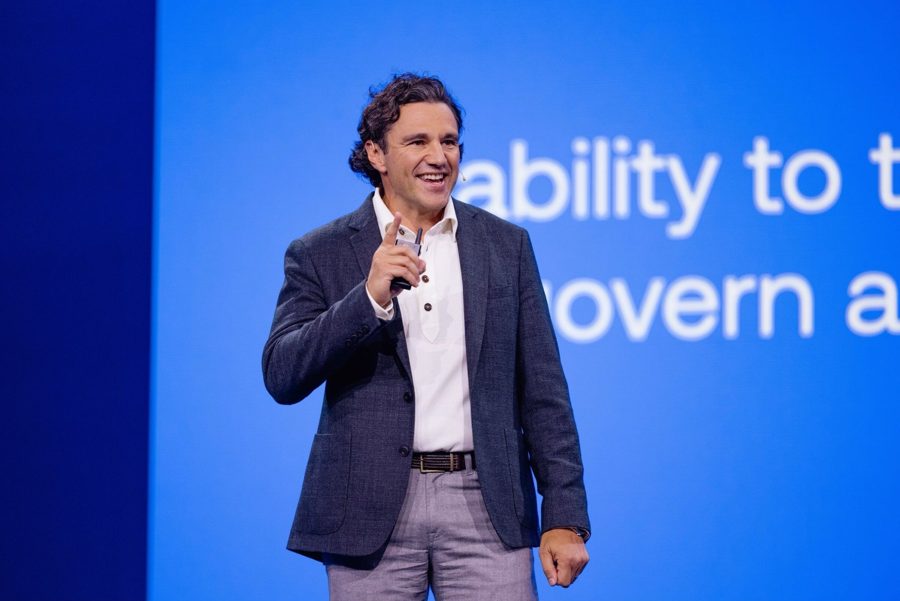
It was great sharing the stage yesterday for the Oktane keynotewith Adriana Corona, Anna Simmons, Jason Fehrenbach, Elizabeth Baier, and Jeff Taylor.
Together, we outlined two pillars of Okta’s strategy: an agentic control plane that unifies agent identity management and security, and a unified identity security fabric for human, non-human, and agentic identities.
These pillars are tightly connected. Agents do not require an entirely new identity model. They need the same level of rigor for access, credentials, and governance as human and machine identities.
At the control-plane level, we showed how Okta for AI Agents helps organizations answer the four questions at the center of the blueprint for the secure agentic enterprise: Where are my agents? What can they do? What are they doing? How do I respond?
New capabilities include Shadow AI Agent Discovery for Endpoints to surface unmanaged agents running on employee devices, Configuration Designer to map and govern agent-to-resource connections, and expanded kill switch capabilities in Agent Gateway to rapidly revoke every active token held by a compromised agent.
On the identity security fabric side, Okta Identity Governance automates context-driven controls that eliminate manual review cycles and reduce operational burden, efficiently managing changes in access requirements for the enterprise at scale. Okta Privileged Access enforces just-in-time access for workloads, agents, and administrators, protecting critical resources.
Together, these capabilities help organizations secure every identity, govern every access decision, and scale AI with confidence.
As Oktane comes to a close, I’m grateful for the conversations and collaboration shaping what comes next for AI security. Thank you to our partners, customers, and the entire Okta team for making this week possible.
Learn more about Okta for AI Agents innovations here:
https://bit.ly/4y73IMd
**Agent SSO is now Generally Available**
Despite how quickly enterprises are deploying AI agents, only 34% apply the same identity and security controls to them as they do to human employees. The default workaround has been static API keys and unmanaged connections, leaving agents operating without centralized policy enforcement or governance audit trails.
Today, Okta announced the General Availability of Agent SSO, extending our core SSO offering to AI agents and bringing the open Cross App Access (XAA) protocol directly into our identity platform. This means that all of our SSO customers now have access to the Agent SSO feature as part of their SSO product entitlement. Just as SSO centralized human access decisions at the identity provider layer, Agent SSO shifts agent authorization from individual applications directly to enterprise identity.
When an XAA-supported agent connects to an enterprise app, Agent SSO registers it directly in Okta’s Universal Directory as a first-class identity. Security teams can govern agents like Claude natively, managing policies and access without forcing users to handle static credentials or constant consent screens.
Agent SSO is a foundational layer of the blueprint for the secure agentic enterprise, helping organizations answer three core governance questions:
• Where are my agents? ➡️ Centralizes visibility by registering every supported agent as a first-class identity.
• What can they connect to? ➡️ Replaces static API keys with XAA, issuing short-lived, scoped tokens to limit agent access to approved enterprise apps and MCP servers only.
• What can they do? ➡️ Extends Okta for AI Agents to deliver continuous visibility, lifecycle governance, and real-time policy enforcement as enterprise AI agent deployments scale.
Enterprise identity shouldn't stop at humans, and securing AI agents shouldn't require a new playbook. Agent SSO brings them into the same identity framework enterprises already use to govern access.
Read more here: https://bit.ly/3UB4CS5
Last week, I had the pleasure of speaking at the FirstMark Guilds Summit about our recent 90-day AI transformation journey at Okta. While navigating the tactical realities of scaling AI is messy, zooming out reveals a massive macro shift in how we build software.
Here is a summary of the two paradoxes I discussed that are currently reshaping the enterprise landscape:
1. The Intelligence Abundance Paradox
- The boardroom question everyone seems to be asking is: "Will AI let us cut our engineering headcount by 50%?". This stems from a flawed scarcity mindset.
- Driven by Jevons Paradox: Historically, when technological progress makes a resource highly efficient and cheap, we don't consume less of it; demand explodes, and we end up consuming exponentially more.
- The Cost of Logic: AI has commoditized software intelligence, dropping the raw cost of generating code and system reasoning to near-zero.
- The New Bottleneck: The constraint is no longer human labor or engineering capacity. It shifts entirely to enterprise imagination, leadership, and raw ambition.
The Bottom Line: We aren’t trying to build the same amount of software with fewer people. We are empowering elite, high-agency teams to solve 10x more customer problems and chase 10x more market opportunities.
2. The Democratization Paradox
- As AI becomes ubiquitous, execution completely equalizes. This leaves us with a critical truth: The more pervasive AI becomes, the more uniquely human choices matter.
- The Model Era is Solved: From 2020 to 2023, the differentiator was "who has the model?". Today, frontier LLMs are baseline infrastructure—table stakes, just like electricity or cloud computing.
- Speed is Commoditized: From 2024 to 2026, the battlefield shifted to "who ships the fastest?". But when anyone can build a functional app in an afternoon, raw developer velocity alone is no longer enough to win.
- The Strategic Shift: Moving forward, the ultimate test becomes "Who builds the right thing?".
- Human Differentiators: When execution is a commodity, your only true differentiators move up the stack to strategy, taste, judgment, deep customer empathy, and the strategic discipline to know what not to build.
**The Big Takeaway **
The shift to agentic product development is not a technical challenge; the models are ready, and the tooling is here. It is an organizational habit-change challenge. It requires breaking decades of deeply ingrained muscle memory around how software is scoped, reviewed, and deployed.
Do not wait around for a perfect, pristine codebase or a flawless model. Put together a tight, 90-day internal sandbox, embrace the initial friction, and fall in love with the 1% compounding gains. In an era of infinite software abundance, the teams that master the internal engine first will define the future.
One of the more important trends emerging in enterprise AI right now is the gradual collapse of the distinction between orchestration and governance.
In traditional software systems, orchestration was mostly operational. Workflow engines coordinated tasks, APIs exchanged data, and identity systems enforced relatively static permissions around those interactions. Governance largely existed alongside execution rather than inside it.
Agentic systems fundamentally change that relationship.
Once AI agents become persistent, tool-using, and capable of delegating work across systems, governance can no longer operate as a separate layer. The workflow itself becomes the governance boundary.
This is why I think the idea of an “agent control plane” is starting to gain traction across the industry. Not because enterprises suddenly want more dashboards, but because autonomous execution creates entirely new infrastructure requirements:
1. continuously verifying execution authority instead of relying on standing privilege
2. preserving provenance across multi-agent workflows
3. dynamically attenuating permissions as context changes
4. maintaining immutable evidence chains for autonomous actions
What makes this especially interesting is that the operational failures often emerge from ordinary system behavior rather than malicious intent. Individually valid actions can compound into unsafe outcomes once agents coordinate across multiple systems at machine speed.
That is a fundamentally different problem than traditional IAM was designed to solve.
I suspect this is why identity is increasingly evolving into something much broader than authentication infrastructure. In AI-native systems, identity becomes the mechanism that binds together execution context, policy enforcement, accountability, and trust across autonomous workflows.
The companies that solve this well will probably shape the next major control layer of enterprise software.
Sources:
https://lnkd.in/ecgGDUeR
https://lnkd.in/ec5gXbdt