Okta's 2026 Businesses at Work report is here. For over a decade, we’ve tracked how organizations adopt and secure the technologies that power modern work. This year, the data points to a clear identity gap: organizations are moving quickly to deploy AI agents, but the infrastructure required to secure them is still catching up. Here’s what stood out:
🤖 Non-human identities are multiplying fast. Centrally managed service accounts grew 650% YoY, signaling that organizations are moving to centralize control as AI agents scale.
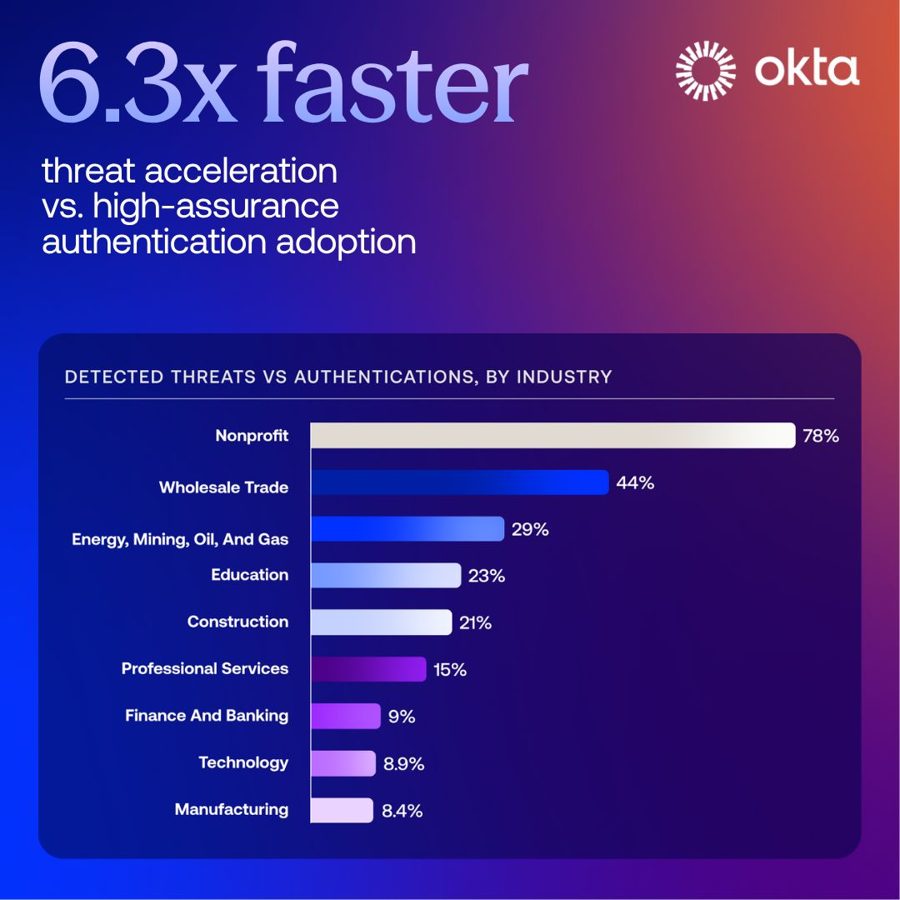
🧑💻Phishing-resistant authentication is more critical than ever. High-assurance MFA grew 8% YoY, but the threat landscape is accelerating 6.3x faster than the adoption of necessary protections.
🏛️Governance needs to operate continuously. With access requests per company up 1140% over two years, organizations need automated, always-on governance to keep AI agents operating within the right controls as access decisions grow in volume and speed.
📈Nonprofits are facing disproportionate risk. Our Nonprofits at Work 2026 report found nonprofits face a 78% ratio of detected threats to authentications – the highest of any industry in our dataset.
The takeaway? Secure Agentic Identity. Make identity the control plane, so organizations can understand, manage, and protect and answer the 3 fundamental questions: where are their agents? What can they connect to? And what can they do?
Dive into the full report here: https://bit.ly/49kYulq
Our AI Agents at Work 2026 survey is now live. The data reveals a critical gap: while executives feel confident about AI governance, the reality shows widespread shadow AI use and security risks. This is precisely why organizations need Okta's clear blueprint for becoming a secure agentic enterprise.
What the data told us 👇
Executives are overconfident. Shadow AI is widespread.
90% of executives are confident in their organization’s visibility into AI tools, and 95% are confident employees are using AI responsibly. However, 52% of employees admit to using AI tools without approval, often via personal accounts.
Governance gaps are resulting in real-world consequences:
More than half of executives (58%) reported that their organization experienced an AI-related security incident or a close call in the past year.
Employees share sensitive information and access with AI tools:
Of those using unapproved AI tools, over half (54%) share internal messages and emails, 45% share HR-related information, and 39% share confidential company documents.
AI policies are unclear:
While 65% of executives believe their organization’s AI usage policies are “very clear,” more than half of knowledge workers (57%) disagree, finding policies unclear, hard to find, or non-existent.
Identity controls are inconsistent:
Only 34% of organizations apply the same security controls to their agentic labor force as their human labor force.
This is the defining challenge of the agentic enterprise. As AI agents become more deeply connected to enterprise systems, apps, and sensitive data, organizations need a much clearer understanding of where their agents are, what they can connect to, and what they can do.
The companies that will lead in the AI era won’t be the ones adding the most restrictions. They’ll be the ones making secure AI adoption easier, with governance built in from the start.
Dive into our full report here: https://bit.ly/3PHwDWe