Recent posts that drew 100 reactions or more and say something a peer would learn from, most reactions first. Click any post to open it on LinkedIn.
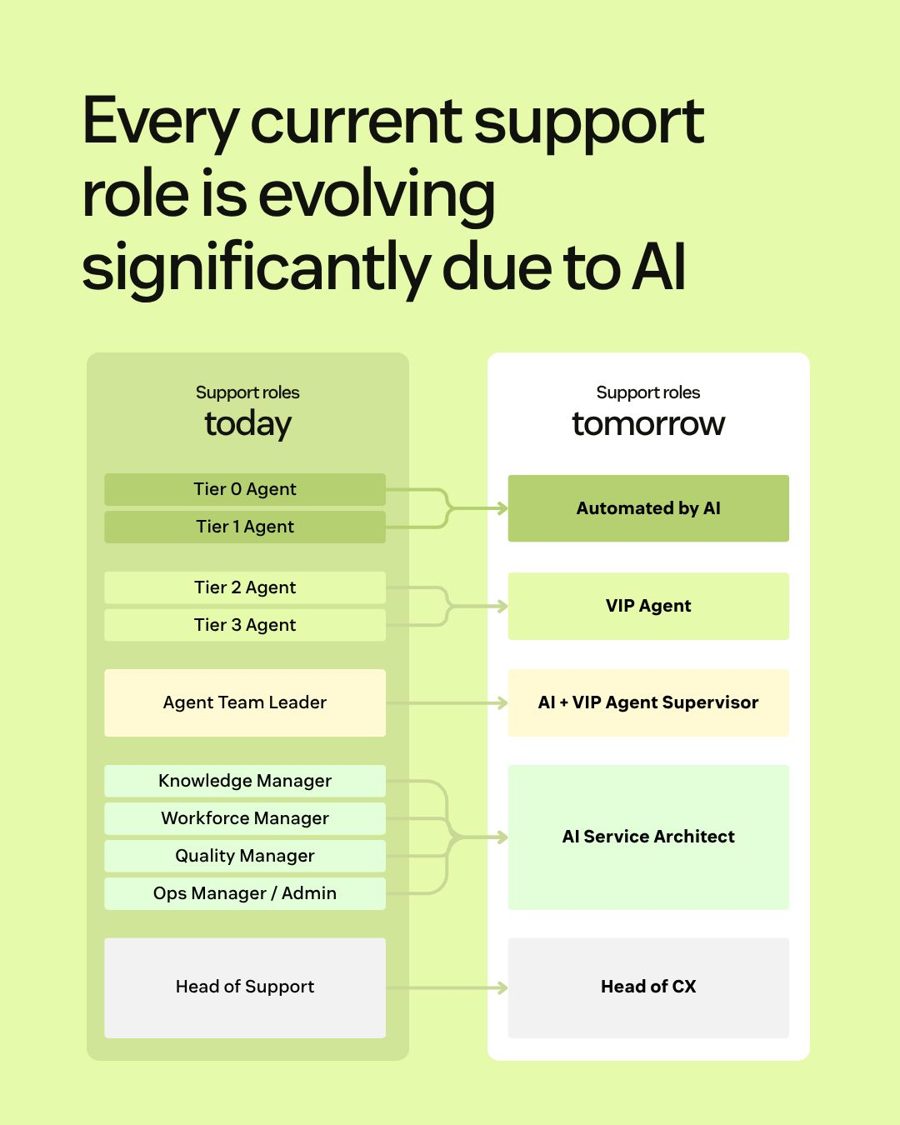
Last week I shared the surprising fact that customer service hiring is still growing even as AI takes on more support work. I gave three reasons why we think that is happening. The third reason was that jobs themselves are changing, not disappearing. This week I want to talk more about how we are already seeing roles change in a support organization. The headline is that every current support role is evolving significantly because of AI.
Let’s start with the frontline. Tier 0 and Tier 1 support agents have always handled the basic, repetitive requests, which are exactly what AI automates best now. This means those roles can become fully automated and the people in them will need to upskill to move into other parts of the support org. Many of the tasks of Tier 2 and Tier 3 support agents can also be automated, so they will have more time to focus on the highest value interactions and hardest escalations as VIP Agents. And there is more of that work, not less, because as we’ve already seen in our data at Zendesk, automation drives escalation. Make it easier to reach out and get good help and people do it much more often. The conversations that still reach a human are the ones that matter most.
Next, the agent team leader is still developing people, but now those people are VIP Agents, and the bigger change is that the same leader is also now supervising AI. The job becomes making sure the right worker is on each part of an interaction, whether that worker is human or AI.
Then, the shift I find most interesting is in the specialized roles. Knowledge, workforce, quality and operations managers, plus admins, are all converging into something new we call the AI Service Architect. Their work is now to capture what great human teams do, the way they resolve an issue, calm a frustrated customer and find the right answer. They need to encode that into procedures AI can follow and replicate at scale. It is the same move our own engineers are making at Zendesk. A dozen of our scrum teams no longer write their own code. They steer the AI, build the skills, add context, and edit prompts to create product. The AI Service Architect does that for support, and I’m excited to share more about this specific role soon.
Finally, at the top of the org, the Head of Support is becoming the Head of CX, responsible for designing and overseeing the entire customer journey rather than just the queue. Support stops being the place complaints land and becomes proactive, cross functional and value oriented. The terms support and CX have been used interchangeably for years, but the role is only now catching up to the language.
Look across the whole org chart and the pattern is consistent. The tasks get automated, but the reason the role exists stays, and the org chart doesn’t disappear, it moves up. Next week I want to get into why that is, because a job was never just a list of tasks.
A couple weeks ago, I wrote that the rituals of customer service were invented in call centers in the 1960s. Hold music is one of those rituals, and it turns 60 this year. The inventor of hold music was Alfred Levy, whose patent for a telephone hold program system was granted in 1966. Levy discovered the solution by accident when a loose wire at his factory touched a metal girder and started picking up a local radio station, piping music to callers on hold. What makes his patent interesting is that he wrote down the better answer on page one, which was not hold music, and then explained why nobody would use it.
Courteous practice, he said, requires that a held caller be assured at reasonable intervals that the person they want is still busy, but the pressure of the operator's duties may prevent them from doing this. Levy wrote that the correct answer was a human periodically reassuring the caller, identified the reason it does not happen as the operator being too busy, and then offered music as the substitute.
The problem Levy was solving is that a caller on hold hears nothing, decides the line is dead or the call has been forgotten, and the call gets abandoned altogether or remade, which he called a waste of time and money. Music was proof the line was live and the thing you could automate in 1962 when the capacity for periodic reassurance was not.
A study from 20 years ago tested what actually keeps people on hold. Researchers at Technion placed 123 real telephone calls and compared three different hold experiences: music alone, apologies delivered at intervals, and announcements telling callers their position in the queue. Queue position announcements led to the lowest abandonment rates, while music and apologies both fell short. What kept people on the line was not sympathy, not reassurance that someone cared, and not hold music, but being able to tell they were making progress toward resolution.
AI changes what is possible. An AI agent picking up the call knows who is calling, what they bought, what broke last week and where the case stands. It can explain specifically where the caller is in the queue and what progress is being made, or it can resolve the issue immediately so the wait does not happen at all. Levy knew in 1962 that periodic human contact was better than silence. The research proved it was specifically progress information that mattered. AI is what makes it possible to finally deliver what the research showed actually works, at a scale that human operators never could.
Meeting customers where they are no longer always means adding another support channel.
At Zendesk, we recorded roughly 2 billion requests to Help Center URLs from AI bots and crawlers in the last 30 days, up 2.5× from the same period a year ago. Most of that traffic came from AI lab crawlers seeking pretraining data for their models, underscoring the value they see in the support instructions and procedures published across 50,000 Zendesk Help Centers.
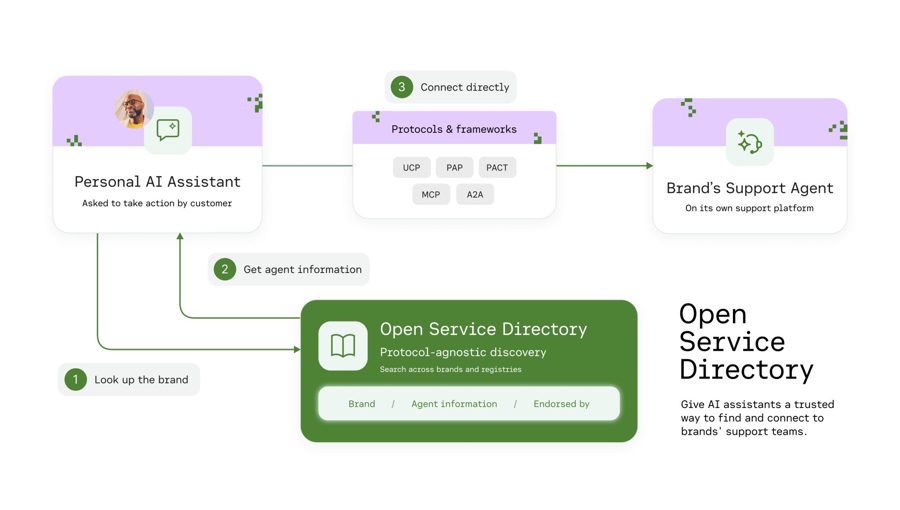
When a customer's request needs action, their personal assistant needs a reliable way to reach the business's official support. Getting the work done requires accurate and complete knowledge, access to the right systems and permission to act.
An assistant might explain how to reschedule a repair appointment. It should also be able to arrange that change through the business's official support, with the customer's approval and within the business's policies. The customer should not have to find the right website and start again because they began with their assistant.
That is the role of Zendesk's Open Service Directory, helping personal assistants find a brand's verified support and connect to it with the customer's permission. Customers should have more flexibility in how they get help, including through the AI assistant they already use.
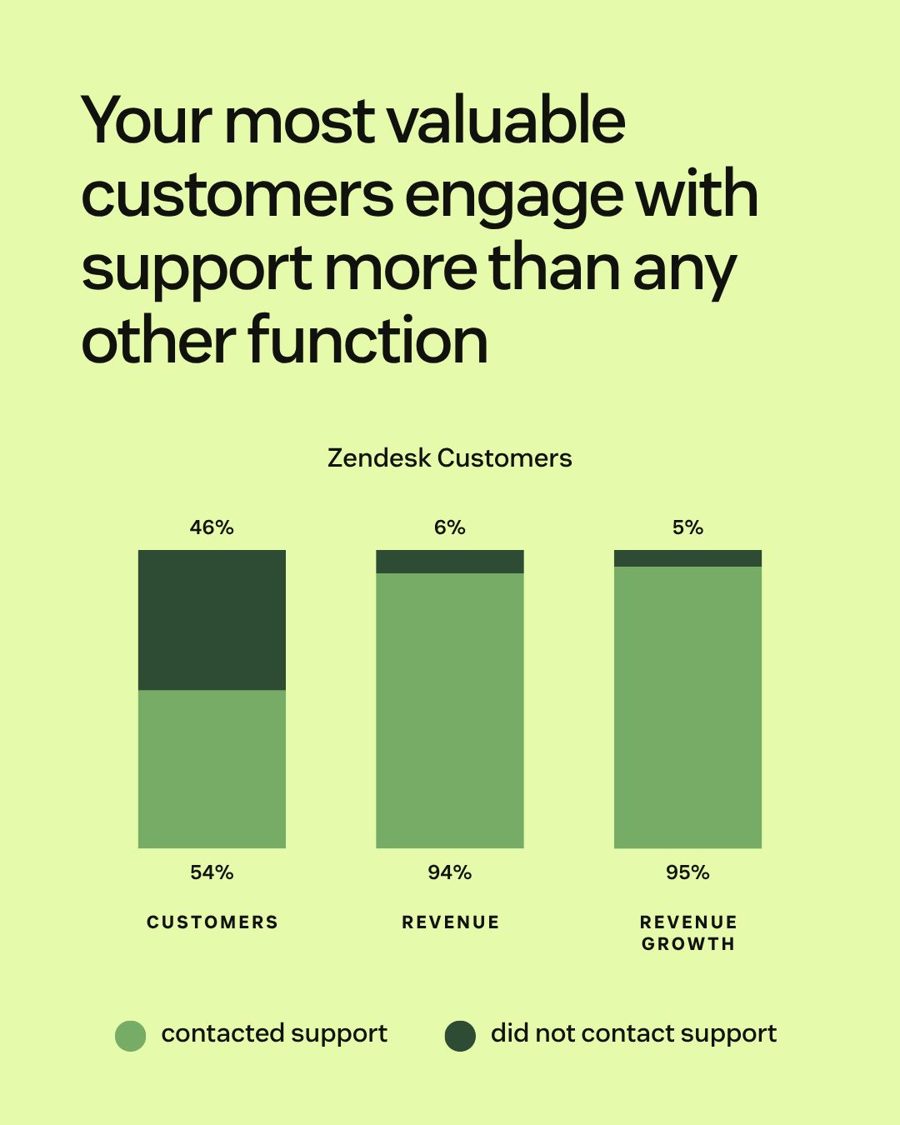
Support is the most consistently undervalued function in business, yet it engages your most valuable customers more than any other.
Take our own customer base: the 54% of customers who contacted Zendesk support this past year drove 94% of revenue and 95% of our revenue growth. Those aren’t one-off users, but the core group most engaged with our products.
It makes a certain amount of sense when you think about it. Customers who use a product seriously tend to have more complex needs, more users depending on it, and more at stake when something goes wrong. Of course they contact support more, they have more reasons to.
Most companies look at high-contact customers and see a cost problem. That is one way to look at it, but contact correlates with commitment. The customers who never contact you are not quietly satisfied. They simply never had enough going on with you to pick up the phone. The ones filing tickets are a different story: they depend on the product enough that it actually matters when something goes wrong. Those are not accounts you want to manage down.
Support almost exclusively deals with the accounts driving your growth. Companies that treat it as a cost center have not looked closely enough at who it actually serves. Support isn't a cost center handling complaints. It's where your most important customers go when something matters. Treat support as one of your most strategic functions, not an operational burden.
Two weeks ago, I wrote about a number of the specialist roles in customer service converging into a new role we call the AI service architect. This is one of the biggest changes we've seen to customer support roles and worth a deeper dive. The job of the AI service architect is to take what your best agents do to resolve complex issues and capture the process precisely enough that AI can replicate it reliably.
Teaching AI is a lot like onboarding a new employee. You give a new hire context, knowledge, access to your systems, data, and some sense of when to act and what to ask. An AI agent needs all of that too. The difference is that a new hire picks up a huge amount of context through osmosis. They learn just by sitting near people who know the job. Organizations need to replicate this context graph for AI. Some of it you write down and some comes from systems integrations, but all of it is deliberate.
Making this transition requires significant change management and the instinct is to hire for it. Usually that is wrong. The person who knows which cases go sideways and why is already on your team. What they lack is time, permission, authority, and guidance.
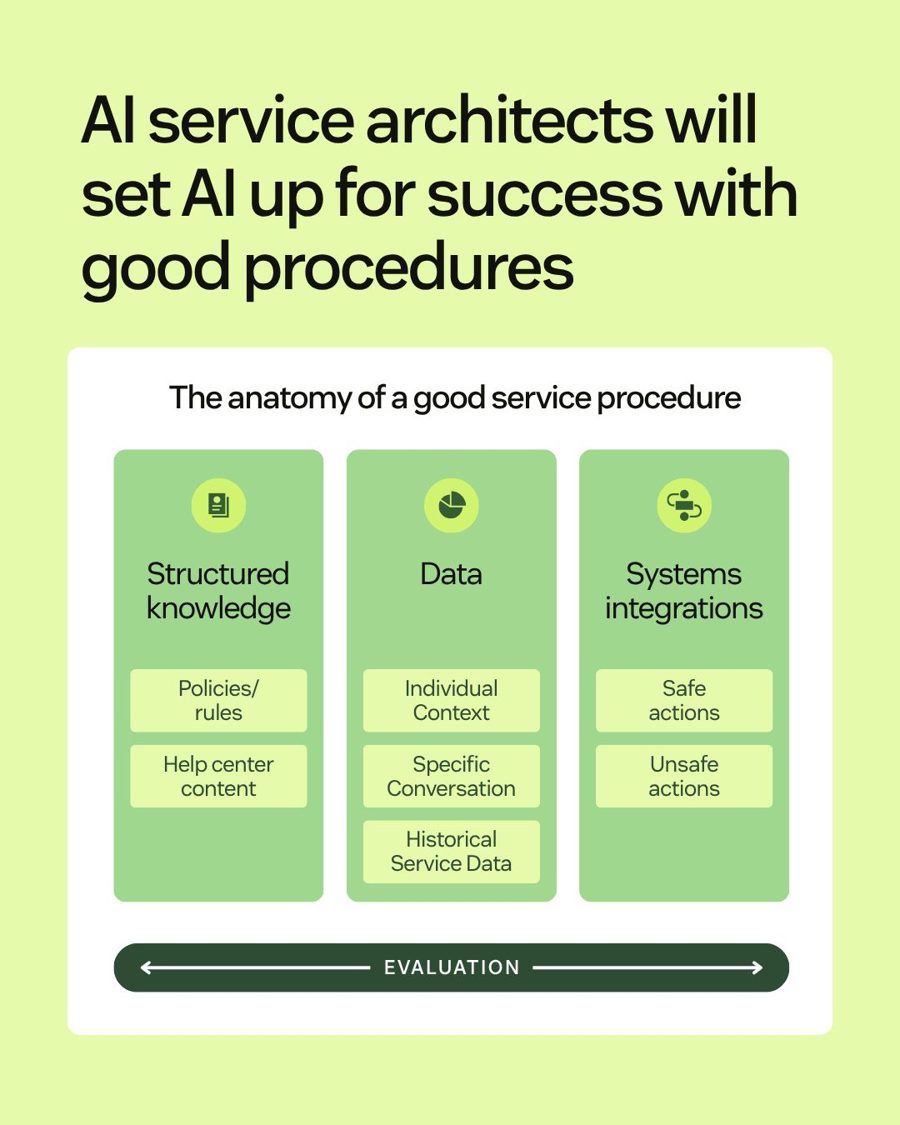
Everyone in service can write a help center article or a standard operating procedure for another human, but writing context complete enough to hand to AI agents requires a different set of skills entirely. First, structured knowledge captures the policies and rules the business really runs on. These are more prescriptive and procedural than public-facing content. Next, data provides complete customer context, insight into the conversation at hand, and enough history to see how similar cases played out. Finally, systems integrations provide a deeper understanding of the customer and the ability to take action on their behalf.
Underneath all three sits evaluation, the part almost everyone skips. A procedure should constantly be tested against interactions you have already resolved previously. That is what makes this work closer to engineering than administration. You pick one intent, get it right, test it, ship it, keep testing it, then start on the next. That is the hill climbing that raises automation rates, sprint by sprint.
This entire role is new, fluid and still a work in progress. Agility and flexibility are the most important qualities when facing such a disruptive technology. There will need to be training, ramp time, and room to experiment and learn.
Some agents may worry that they are training their replacement. They are not. They are handing over the part of the job that no longer needs a human and getting back to their core purpose. The work stops being about resolving one case at a time and becomes about making sure every case is resolved as well as it possibly can be.
The holiday season is fast approaching. Most teams watch inventory, delivery, and support staffing. Another thing worth watching, one most teams overlook, is a rise in “Where is my order?” contacts.
Known as WISMO contacts, short for “Where Is My Order,” they made up roughly 4% of classified support volume across all our customers in 2025.
There are two kinds of WISMO contacts. One is a question: where their order is, when it will arrive, or how to track it. The other is a problem: their order is late, never arrived, or is lost. On average, roughly 51% are status questions and 49% are delivery problems. Both arrive under the same “Where is my order?” label, and they are hard to tell apart at intake. As a result, the whole bucket gets treated as basic, repetitive volume to automate away or push to self-service.
Automating that bucket of inquiries is the right move. The mistake is stopping there and losing sight of how the volume of basic questions is changing. Last holiday season, we looked at every anonymized WISMO ticket and split them into status questions and delivery problems. The status questions started rising about a day before the delivery problems. To check, we tracked how each volume changed over time, then slid one curve across the other a day at a time to see where their rises and falls matched most closely. The closest match came when the delivery problems sat one day behind the questions. At that fit, the correlation was 0.96, almost a perfect fit, with the questions consistently a day ahead.
You might think a customer asks where their order is, then reports it lost. Mostly, that isn’t what happens. Only 0.7% of the status-question tickets later picked up a delivery-problem label. The pattern is across the base, not within a single order. When a wave of “Where is my order?” questions comes in, a wave of late, lost, or missing orders tends to follow about a day behind.
That isn’t surprising, and the value isn’t the prediction but the day of lead time. The catch is that lead time only helps if you can still see the signal. When you automate away a repetitive request, you remove the work, and you can remove your visibility into the pattern underneath it. The contact disappears, and with it your early view of shipping falling behind or fulfillment backing up. The labor is gone, but the insight shouldn’t be. Automating away the ticket isn’t the same as automating away the problem.
The practical move is to keep a seasonal baseline alert on the volume of every question type you have automated away, not just WISMO. Anything you deflect in volume, you should still measure in trend, because a shift there signals that something upstream has changed. When one fires, look at what is upstream of that question, the process, partner, or promise it depends on, and proactively notify customers so they don’t have to open a support request to find out.
The basic questions are worth automating away, but don’t lose sight of the signal they carry.