Every company wants to rein in their AI spending, but that is hard to do by looking at token cost alone.
Say you hire someone because they have a lower hourly rate, but then they take twice as long to finish the work. Suddenly, the whole project could end up costing more overall.
The same is true for models. As more become available, companies will need to figure out which ones work better for certain tasks and hire accordingly. In some cases a frontier model might be your best option because it takes less turns to complete the job or produces higher quality results.
At Zendesk, we use cost per task to pair the right model for the work being done. Our specialized agents, for instance, need to understand what a customer is asking for, pull the right information, apply the company’s policies, and take authorized action across its systems. That is very different work from a co-pilot that needs to summarize tickets, suggest replies, and recommend follow-up actions.
By taking this approach, we are able to improve performance while making the work more cost-efficient. Our average cost per task dropped 22% in August, compared to the month prior. As we continue to evaluate new models and capabilities, I expect that trend to continue.
Personal AI assistants are moving from answering questions to getting things done. Muse and Instinct point to the next shift: people are now asking assistants to do everything from managing subscriptions to making reservations and following up on issues.
For service, the assistant may understand the task, but it needs a verified way to find the brand’s official support. If it can’t identify the right destination, it may rely on outdated information or leave the customer at a dead end.
Today, Zendesk is introducing Open Service Directory (OSD), an open specification and public directory of verified support destinations. It helps personal assistants find and reach official brand support across service platforms. Once connected, the brand’s authentication, permissions, and policies govern what happens next.
I believe AI agents on both sides of service will increasingly work together. The industry needs a shared, open way for a customer’s assistant to find the right place to start. We’re inviting brands, CX platforms, and AI agent builders to help shape it: https://zdsk.co/4zlL2sa
Nobody is asking me if AI works anymore. They are asking if it works within their specific rules, workflows, and business culture.
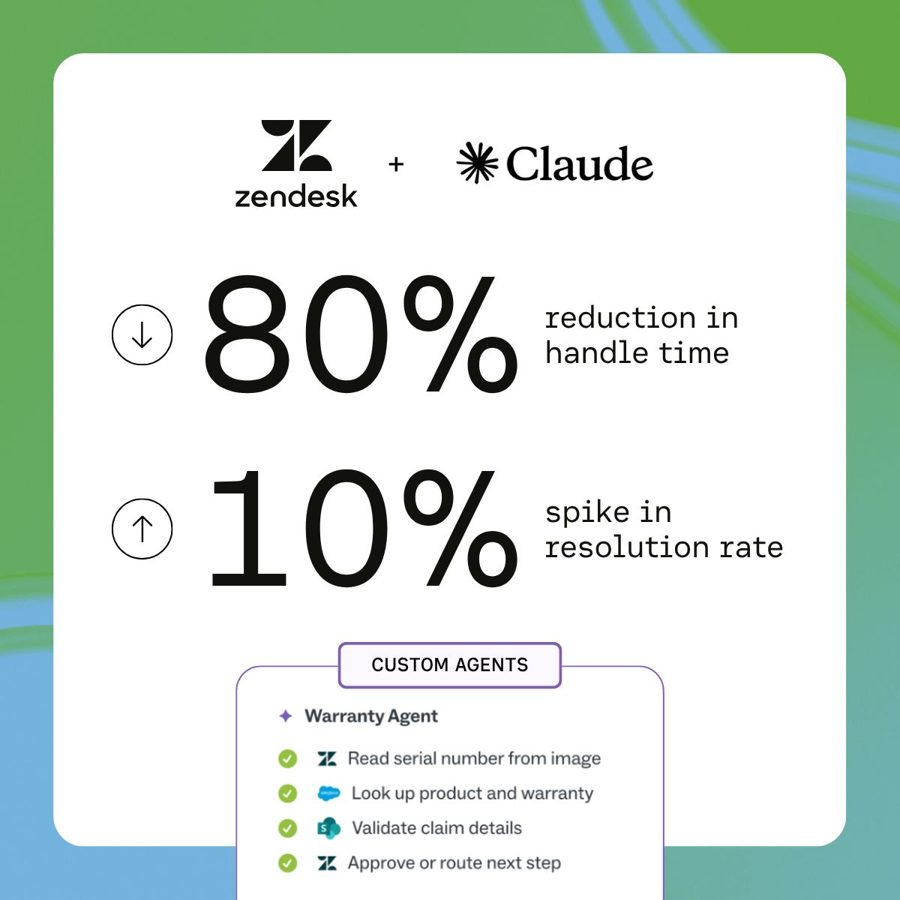
In their first seven weeks of early access, customers ran Zendesk Custom Agents more than one million times. Some are seeing handling times drop by up to 80%.
That is what it looks like when AI can take on complex service work shaped by each business’s own systems and processes. Custom Agents that we have built on Claude are one way we are bringing Specialized Agents to life, helping customers automate work that once took months to build themselves, with agents they can configure in as little as 30 minutes.
Thank you to Abhiney Kathuria, Brett Schuenemann, and the team, and to our partners at Anthropic and Amazon Web Services (AWS). There is a lot to be excited about in what customers are doing with this technology, and how quickly we’re building it together.
Read the full story here: https://zdsk.co/4AVkC1X
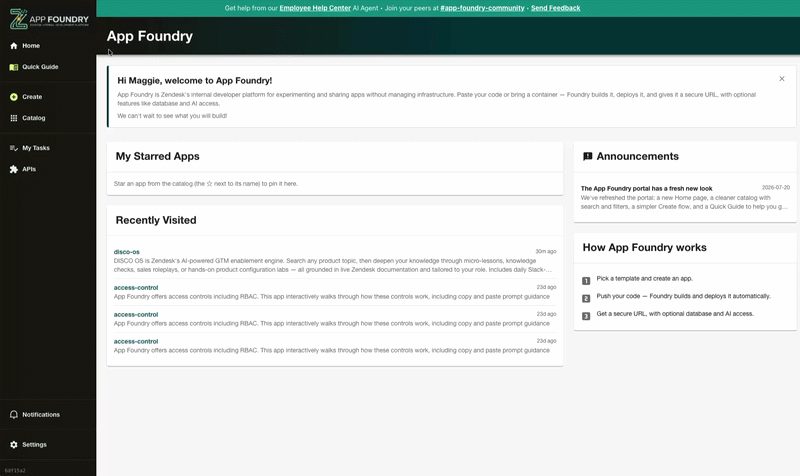
As technology matures, it becomes more accessible. Bulky computers that used to require special punch card instructions have given way to unbelievably powerful computing in the palm of our hands. I may not have been able to program anything on my dad’s Commodore VIC-20, but now I can build an app simply by typing into a browser in plain language.
For companies, this opens up a much larger opportunity than individual productivity. AI makes it possible for anyone to be a creator. It opens the door for anyone to build, engineer, design, and move at a pace that was previously impossible. When we gave everyone access to AI tooling at Zendesk, we saw a flood of new apps created, but we also were confronted with how to secure data, prevent siloes, maintain a high quality bar, and ultimately channel this energy into supporting our larger business priorities.
We solved for these by building App Foundry, our internal development platform. It gives each of our employees a space to deploy the things they create and share them across the organization. Having a deployment option that is fully integrated with our security and governance infrastructure also makes it possible for us to say yes to builders while keeping our enterprise safe.
In the first three months alone, hundreds of builders have published more than 600 applications to the platform. One of my recent favorites is Zencyclopedia, an internal LMS created by Jeff Haynes for our field teams. It provides a faster way to find product answers, locate the right supporting material, and promote deeper learning through courses and certifications.
This is the builder culture we are working to foster at Zendesk. We want our employees at the frontlines, with a clear path for turning their expertise into something the entire company can use. A massive thank you to Craig Flower, Christian B., and Daniel Watrous, MBA for leading this work.